About Myadestes melanops Salvin, 1865
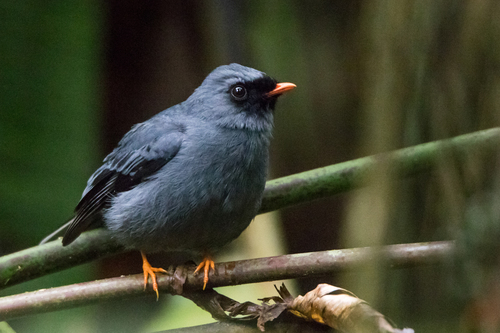
The black-faced solitaire (Myadestes melanops) is a bird species in the thrush family, endemic to the highlands of Costa Rica and western Panama. It lives in dense undergrowth and bamboo clumps in wet mountain forests, typically at altitudes between 750 and 3,000 m (2,460 to 9,840 ft). In the wet season, it may disperse to altitudes as low as 400 m (1,300 ft) and form loose flocks during this time. It builds a cup-shaped nest from mosses and liverworts, placing it in a tree crevice, a hole in a mossy bank, or concealed among mosses and epiphytes in a tree fork up to 3.5 m (11 ft) above the ground. Between April and June, the female lays two or three white or pinkish eggs marked with rufous-brown. Fledging takes 15 to 16 days after hatching. This is a slim thrush, measuring 16–18.5 cm (6.3–7.3 in) in length and weighing an average of 33 g (1.2 oz). Adult black-faced solitaires are slate gray, with a black face and chin that contrasts with their broad orange bill. Their wings and tail are black with slate-colored edges, and their underwing coverts are silvery-white, a feature that is clearly visible when the bird is in flight. Their legs are orange. Juveniles have buff streaks on their head and upper body, and buff and brown mottling on their underparts. Black-faced solitaires usually forage low in vegetation. They feed mainly on berries, but also eat insects. They may climb up to the forest canopy or go out into trees in pastures while searching for food. Their call is either a nasal ghank or a liquid quirt, and their song is a beautiful fluty whistled sequence: teedleedlee…tleedleeee…lee-dah…lee-dah. Males most often sing from a shady canopy perch in the evening. The extremely slow song has a wonderfully pure, ethereal quality in its natural habitat. When this species is kept in a cage, however, the song leads to it being commonly nicknamed the "squeaky hinge bird". Black-faced solitaires are still common in protected and inaccessible areas, but trapping this popular songbird for the cage-bird trade has severely reduced populations in other regions.