About Myadestes genibarbis Swainson, 1838
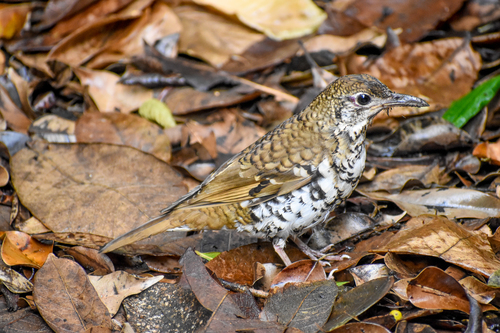
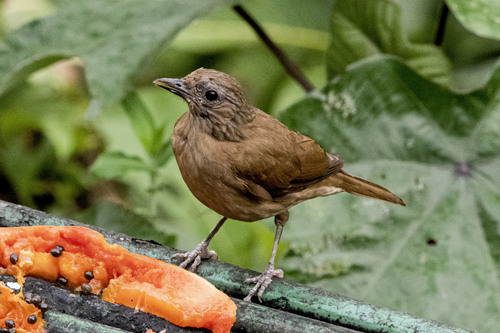
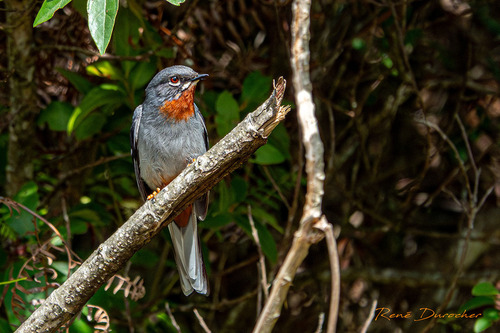
Myadestes genibarbis, commonly called the rufous-throated solitaire, is 19 to 20.5 cm (7.5 to 8.1 in) long and weighs 24 to 30 g (0.85 to 1.1 oz). Males and females have identical plumage. Adult individuals of the nominate subspecies M. g. genibarbis have a slate-gray crown, a white crescent below the eye, and a dark malar stripe on an otherwise orange-flecked face. Their upperparts are slate-gray. Their wings are slate-gray with black primary coverts, black bases on the secondaries, white bases on the inner primaries, and pale edges on the flight feathers. Their tail is mostly slate-gray, with whitish outer feathers. Their chin is whitish, their throat chestnut, their breast medium gray, and their belly and vent ochraceous-tawny. Juveniles are darker than adults. They have orange-buff spots and streaks on their upperparts, orange-buff and slaty scallops on most of their underparts, and plain orange-buff vent and undertail coverts. Each of the other recognized subspecies differs from the nominate subspecies and from one another in the following ways: M. g. solitarius is slightly larger, with a longer tail and a brighter throat. M. g. montanus has a shorter tail, a paler throat, and almost plain ear coverts that are not orange-flecked. M. g. dominicanus has darker gray upperparts, much darker underparts with more gray, and streakier ear coverts. M. g. sanctaeluciae is similar to dominicanus, but has a paler throat, more white in the tail, and more orange on the lower belly. M. g. sibilans has almost black upperparts with olive uppertail coverts, paler underparts, a longer black malar stripe positioned below an ochraceous-rufous stripe, and throat color that blends into the breast. All subspecies of this bird have a black bill and yellowish legs and feet. Each subspecies of the rufous-throated solitaire has a distinct range across Caribbean islands: M. g. solitarius is found on Jamaica, M. g. montanus on Hispaniola (which includes Haiti and the Dominican Republic), M. g. dominicanus on Dominica, M. g. genibarbis on Martinique, M. g. sanctaeluciae on St. Lucia, and M. g. sibilans on St. Vincent. The rufous-throated solitaire primarily lives in dense, moist, lowland and montane evergreen forest in the tropical zone, at elevations from sea level up to 1,800 m (5,900 ft). It can also be found in groves along streams that run through meadows.