About Mutinus elegans (Mont.) E.Fisch.
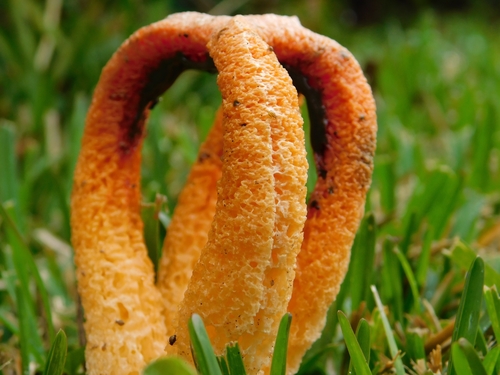
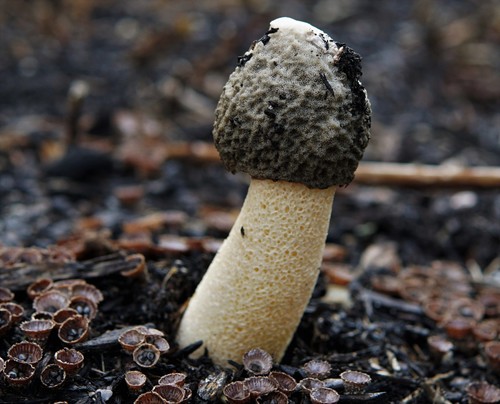
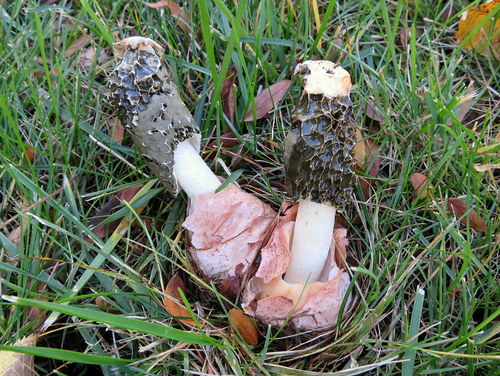
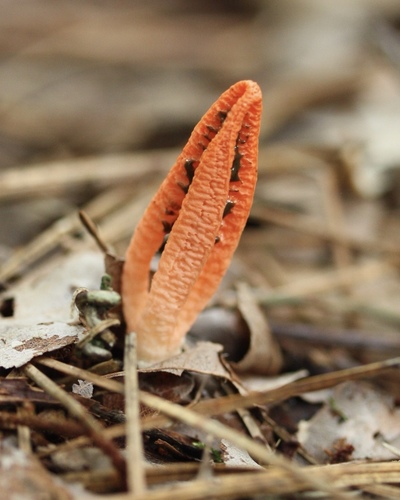
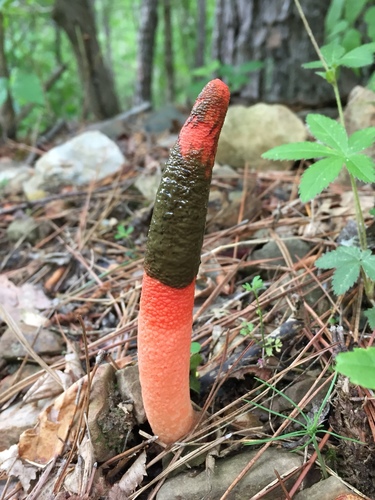
Mutinus elegans (Mont.) E.Fisch. has young fruiting bodies that start out white, spherical or egg-shaped, and are partially buried in the ground, measuring 2 to 3 cm (3⁄4 to 1+1⁄4 in) by 1 to 2 cm (1⁄2 to 3⁄4 in). As the fruiting body matures, the outer egg layer ruptures and a spongy spore-bearing stalk emerges. A fully grown stalk ranges from 1 to 15 cm (1⁄2 to 6 in) long and 1.5 to 2 cm (1⁄2 to 3⁄4 in) thick. The stalk is hollow, strongly wrinkled all over, and cylindrical toward the base, gradually tapering to a narrow tip with a small opening. The upper half of the stalk is bright red to reddish orange, and the color fades gradually to pinkish white toward the base. The stalk may be straight or slightly curved. Newly emerged specimens have a gelatinous greenish-brown gleba covering the upper third of the stalk. Remains of the original outer egg form a volva around the base of the stalk. The gleba has a foul odor; one author describes it as sickly sweet or metallic. Spores are greenish-brown in color, measuring 4–7 by 2–3 μm; they are oblong-elliptical, smooth, and embedded in the gleba. Fruiting bodies attach to their growing substrate via whitish root-like rhizomorphs. American mycologist Alexander H. Smith observed that the immature egg stage is often slow to open, sometimes taking up to two weeks before the stalk expands. A 1982 study found that spores of Phallaceae species, including Mutinus elegans, have a hilar scar 0.2–0.3 μm in diameter that can be seen with scanning electron microscopy. This hilar scar is a circular indentation at one end of the spore, most likely formed when the spore separates from its attachment to the sterigma of the basidium. Mutinus elegans is saprobic, meaning it gets nutrients by breaking down dead or dying organic matter. It is commonly found in gardens and manure-enriched farm areas, near heavily decayed stumps and logs, and in wood chips. A Japanese publication notes it has been found growing in Takatsuki and Osaka-fu, where it fruits in November and December on the ground along paths or in open areas, under or near bamboo (Phyllostachys bambusoides) and hardwoods including sawtooth oak, Japanese Zelkova, and Camphor tree. This common species has been collected in eastern North America, ranging from Quebec to Florida, and west to the Great Lakes, Iowa, Colorado, and Texas. In Europe, it has been reported from the Netherlands, and in Asia it has been collected in Japan. The immature egg-shaped fruiting bodies of M. elegans are edible, but they are not recommended for consumption. One field guide notes that stinkhorn fungus eggs taste like the seasonings added to them. The foul odor of mature fruiting bodies is likely repellent to most people, but the species is not considered poisonous.