About Mutinus caninus (Schaeff.) Fr.
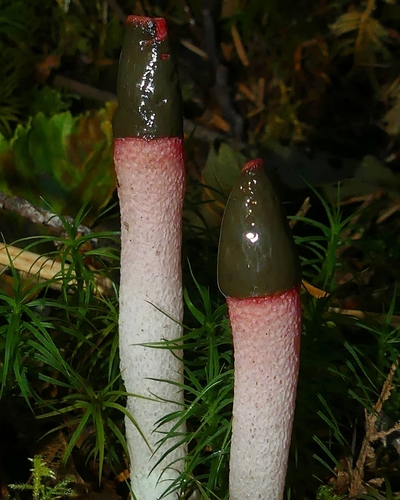
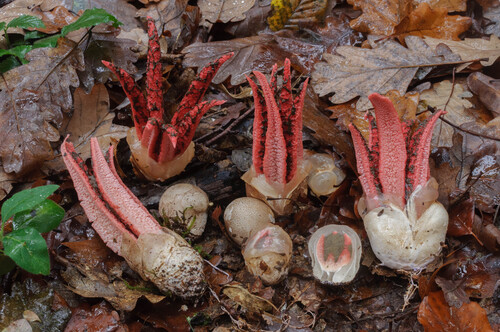
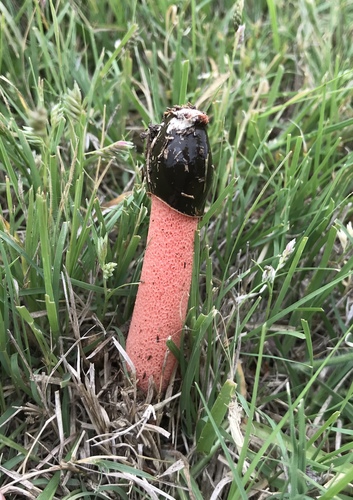
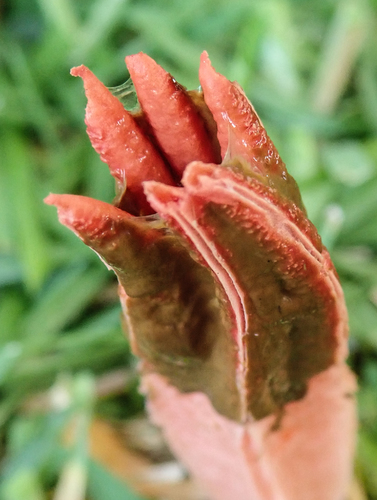
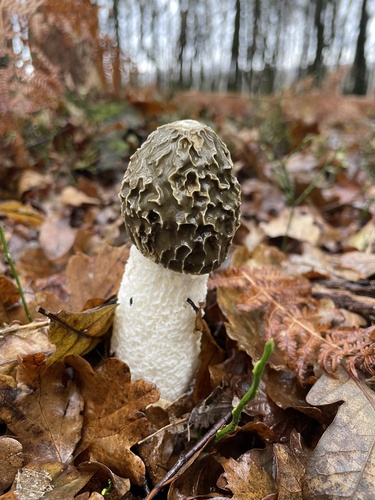
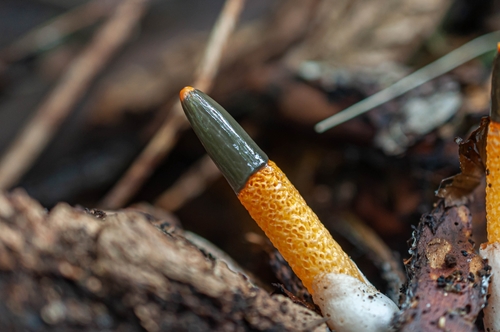
Mutinus caninus, commonly called the dog stinkhorn, is a small species in the Phallaceae family. This fungus starts as an off-white, egg-like immature fruiting body that sits half-buried in leaf litter on woodland floors. White mycelial cords called rhizomorphs are often visible beneath this egg structure, which measures 2–4 cm (1–1.5 in) high and 1–2 cm (0.5–1 in) wide. The egg has a tough outer skin known as a peridium, which encloses a gelatinous inner layer that protects a fully formed but unexpanded mature fruiting body. When the egg splits open, the fungus expands rapidly to its full full height of 10–12 cm (4–4.5 in), usually within just a few hours. The expanded mature structure is roughly 1 cm (0.5 in) thick, and can be yellowish-white, yellow, or pale orange in color. The remnants of the split egg remain at the base of the fungus, forming a volva-like sack. The cylindrical fruiting column is very fragile and pitted, has a pointed tip, and is usually curved. The tip is covered in spore-bearing tissue called gleba, a dark olive-brown paste with a scent that attracts insects. Insects help distribute the fungus's spores by carrying them on their bodies and through their digestive tracts. Underneath the spore mass, the tip of the fungus is dark orange. While its scent is not as strong as that of the related common stinkhorn Phallus impudicus, Mutinus caninus has been described as smelling like cat faeces. An albino form of the fungus, Mutinus caninus var. albus, was described by American mycologist Sanford Myron Zeller from collections made in Warrengon, Oregon. This variety is essentially identical to the typical form except it is entirely pure white aside from the gleba. It was first mentioned in scientific literature by Edward Angus Burt in 1896. In terms of distribution and habitat, the dog stinkhorn occurs occasionally and is quite common across Europe, Britain, and eastern North America. It is listed on the red data list of Ukraine. A collection from the Canary Islands marks the southernmost known record of the species in the Northern Hemisphere. It has also been collected in Iran, Turkey, and China, specifically in the Chinese provinces of Hebei, Jilin, and Guangdong. It fruits from summer through late autumn, typically growing in small groups in leaf litter, on wood debris, or along wooded roadsides. It can grow in both deciduous and coniferous woodlands. The fungus's fruit bodies act as a food source for thief ants and for developing blow flies (Phormia regina).