About Mustela putorius Linnaeus, 1758
The European polecat (scientific name Mustela putorius Linnaeus, 1758) is also commonly called the black polecat or forest polecat, and is a species of mustelid. Its range covers Europe and the Rif Mountains of Morocco, and it is widespread across the western Palaearctic as far east as the Urals in the Russian Federation. It is absent from Ireland, northern Scandinavia, most of the Balkans and the eastern Adriatic coast, and only occurs marginally in northern Greece; in Morocco’s Rif Mountains, it lives at elevations from sea level up to 2,400 m (7,900 ft). Its domesticated descendant, the ferret, has been introduced to Britain, some Mediterranean islands, and New Zealand.
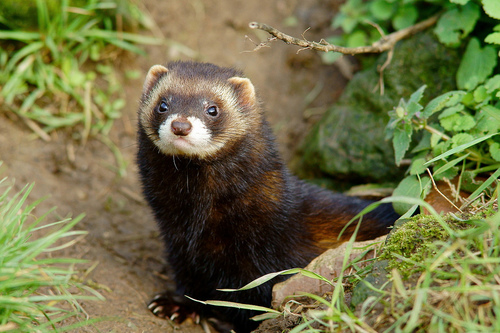
Most European polecats are dark brown overall, with a pale underbelly and a dark dark facial mask. Rare colour mutations do occur, including albinism, leucism, isabellinism, xanochromism, amelanism, and erythrism. Compared to other species in the Mustela genus, the European polecat has a shorter, more compact body, a more powerfully built skull and dentition, and is less agile. It is well known for its characteristic ability to secrete a particularly foul-smelling liquid to mark its territory, but it is much less territorial than other mustelids; animals of the same sex frequently share home ranges.
The European polecat originated in Western Europe during the Middle Pleistocene. Its closest living relatives are the steppe polecat, black-footed ferret, and European mink. It can produce fertile hybrid offspring with the steppe polecat and black-footed ferret, but hybrids between the European polecat and European mink are usually sterile; these hybrids are larger than their parent species and have more valuable pelts. The European polecat is widely accepted as the sole wild ancestor of the domestic ferret, which was domesticated over 2,000 years ago to hunt vermin.
It is a polygamous seasonal breeder that relies on induced ovulation, with no courtship rituals. During the mating season, a male grabs the female by the neck and drags her to stimulate ovulation, then copulates for up to an hour; each male mates with multiple females. Gestation lasts 40 to 43 days, and litters of 5 to 10 kits are usually born between May and early summer. Newborn kits weigh 9–10 g (0.32–0.35 oz) and measure 55–70 mm (2.2–2.8 in) long; they are born blind and deaf. By one week of age, kits grow a coat of silky white fur, which is replaced by a cinnamon brown-greyish woolly coat at 3 to 4 weeks old. Weaning starts at three weeks of age, and permanent teeth erupt after 7 to 8 weeks. Kits become independent of their mother at two to three months old. Females are very protective of their young, and have been recorded confronting humans that get too close to their litters.
The European polecat feeds on small rodents, birds, amphibians, and reptiles. It occasionally cripples prey by piercing the brain with its teeth, and stores the still-living prey in its burrow to eat later.
Historically, humans have viewed the species negatively. In Britain specifically, gamekeepers persecuted European polecats, and the animal became a symbol of promiscuity in early English literature. Today, it still appears far less often in popular culture than other rare British mammals, and misconceptions about its behaviour remain common in some rural areas. As of 2008, it is classified as Least Concern on the IUCN Red List, due to its wide geographic range and large population size.
European polecat hunting was historically a common activity. It was a favoured night-time midwinter sport for Westmorland dalesmen and Scottish hunters. Moonlight hunting of polecats was also a popular pastime for midland schoolboys. Until the mid-19th century, polecat hunting in Britain ran from early February to late April, conducted with mixed packs of hunting dogs on Welsh hills and Lakeland fells; otterhounds were used for hunting on fells, the Border country, and the Scottish Lowlands. John Tucker Edwardes, developer of the Sealyham terrier breed, used captured wild male polecats to test the gameness of yearling terriers. In the former Soviet Union, polecats were hunted mostly in late autumn and early winter using guns, hunting dogs, foothold traps, and wooden snares, but hunters rarely caught more than 10–15 polecats even in open season, and the species was not an important target for commercial hunting, usually caught only incidentally. Most human-caused polecat deaths are accidental, most often from steel traps set for rabbits.
The European polecat is a valuable fur-bearing species; its fur is called fitch, and is more valuable than fur from the steppe polecat. Its skin is primarily used to make jackets, capes, and coats, and is especially popular for trim on women’s clothing. The tail is sometimes used to make paintbrushes. One drawback of polecat skin is its persistent unpleasant odour that is difficult to remove. Commercial fur farming of European polecats first began in Great Britain in the 1920s. The species gained economic importance for fur production in Finland in 1979, and also became economically important for fur in the USSR, but never became popular for fur farming in the United States and Canada due to import restrictions on non-native species.