About Mustela nivalis Linnaeus, 1766
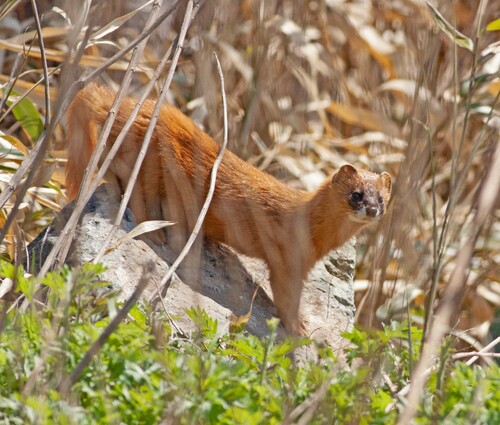
The least weasel (Mustela nivalis Linnaeus, 1766) has a thin, greatly elongated, extremely flexible body, paired with a small yet elongated blunt-muzzled head that is no thicker than its neck. Its eyes are small relative to head size, bulging, and dark colored. Both legs and tail are relatively short; the tail makes up less than half the animal’s total body length. The feet bear sharp, dark-colored claws, and the soles of the feet are heavily covered in hair. Compared to other members of the genus Mustela, particularly stoats and kolonoks, the least weasel’s skull has an infantile appearance, which is most pronounced in the small rixosa group. This infantile trait shows as a relatively large cranium and shortened facial region. Overall, the least weasel’s skull is similar to that of a stoat but smaller, though the skulls of large male least weasels often overlap in size with the skulls of small female stoats. Least weasels usually have four pairs of nipples, which are only visible in females. The baculum of males is short, measuring 16 to 20 mm (0.63 to 0.79 in), and has a thick, straight shaft. Fat is deposited along the spine, around the kidneys, in the gut mesentries, and around the limbs. Under its tail, the least weasel has muscular anal glands that measure 7 by 5 mm (0.28 by 0.20 in). These glands hold sulphurous volatile compounds, including thietanes and dithiacyclopentanes; the smell and chemical composition of these compounds are distinct from those found in stoats. The least weasel moves by jumping, with the distance between the tracks of its fore and hind limbs ranging from 18 to 35 cm (7.1 to 13.8 in). Body dimensions vary widely geographically, a degree of variation rarely seen in other mammals. For example, least weasels of the boccamela group can weigh almost four times as much as smaller subspecies. In some large subspecies, males may be 1.5 times longer than females. Tail length also varies, making up 13 to 30 percent of total body length. On average, male body length ranges from 130 to 260 mm (5.1 to 10.2 in), while females average 114 to 204 mm (4.5 to 8.0 in). Tails measure 12 to 87 mm (0.47 to 3.43 in) in males and 17 to 60 mm (0.67 to 2.36 in) in females. Males weigh 36 to 250 g (1.3 to 8.8 oz), while females weigh 29 to 117 g (1.0 to 4.1 oz). The winter fur of the least weasel is dense, short, and closely fitting to the body. In northern subspecies, the fur is soft and silky, but it is coarse in southern forms. Summer fur is very short, sparser, and rougher than winter fur. The upper parts of the body are dark in summer fur, with geographic variation ranging from dark-tawny or dark-chocolate to light pale tawny or sandy. The lower parts of the body, including the lower jaw and inner sides of the legs, are white. A brown spot is often present at the corner of the mouth. The dividing line between the dark upper fur and light lower fur is usually straight, but may sometimes be irregular. The tail is brown, and sometimes the tip is slightly darker, but it is never black. In the northern part of the species’ range and at high altitudes, the least weasel changes its coat color in winter, turning pure white, with a small number of black hairs present only in rare cases. The least weasel has a circumboreal, Holarctic natural distribution that covers most of Europe, North Africa, Asia, and parts of northern North America. It has been introduced to New Zealand, Malta, Crete, the Azores Islands, and São Tomé off the coast of West Africa. It occurs across all of Europe except for Ireland, and lives on all major Mediterranean islands. It is also found on Honshu and Hokkaido Islands in Japan, and on Kunashir, Iturup, and Sakhalin Islands in Russia. The least weasel inhabits fields, open woodland, bushy and rocky areas, parks, and gardens, at elevations up to around 3,000 m (9,800 ft). Fossilized remains of the least weasel have been found in Denisova Cave. The least weasel mates between April and July, and has a gestation period of 34 to 37 days. In the Northern Hemisphere, average litter size is 6 kits, and these kits reach sexual maturity between 3 and 4 months of age. Males may mate during their first year of life, though matings in the first year are usually unsuccessful. Males are fecund from February to October, though early stages of spermatogenesis occur throughout the winter months. For females, anestrus lasts from September until February. Females raise their kits without any help from males. Newborn kits weigh 1.5 to 4.5 g (0.053 to 0.159 oz) at birth. They are born pink, hairless, blind, and deaf, but grow a white coat of downy fur by the time they are 4 days old. By 10 days of age, the dividing margin between the dark upper parts and light lower parts of the coat becomes visible. Milk teeth erupt when the young are 2 to 3 weeks old, at which point they begin eating solid food, though lactation can last up to 12 weeks. The eyes and ears open when the kits are 3 to 4 weeks old, and by 8 weeks of age, they have developed killing behavior. The family group breaks up after 9 to 12 weeks. Least weasels produce one single litter per year, and can live for 7 or 8 years.