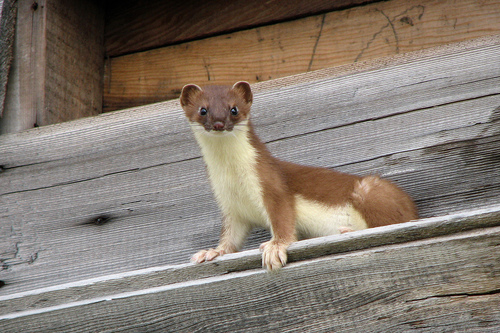
About Mustela erminea richardsonii Bonaparte, 1838
The stoat (Mustela erminea), also called the Eurasian ermine or simply ermine, is a mustelid species native to Eurasia and northern North America. Due to its broad circumpolar distribution, it is categorized as Least Concern on the IUCN Red List. The term "ermine" is most often used to refer to the stoat when it grows its pure white winter coat, or to the fur from this coat. Ermine fur was used by Catholic monarchs in the 15th century, who sometimes incorporated it into the mozzetta cape. It has long been used to trim the ceremonial robes of members of the United Kingdom House of Lords, and also appeared on capes in depictions such as that of the Infant Jesus of Prague. Stoats were introduced to New Zealand in the late 19th century to control rabbit populations, but have caused severe harm to native bird populations, leading the species to be named one of the world's top 100 "worst invaders".
Stoats have a circumboreal range across North America, Europe, and Asia. In Europe, they are found as far south as 41ºN in Portugal, and inhabit most islands with the exceptions of Iceland, Svalbard, Mediterranean islands, and some small North Atlantic islands. In Japan, they live in central mountain areas (the northern and central Japanese Alps) through the northern part of Honshu, mostly above 1,200 m, and on Hokkaido. Their vertical range extends from sea level up to 3,000 m (9,800 ft). In North America, they are found throughout Alaska, western Yukon, most of Arctic Canada east to Greenland. In the rest of North America, and parts of Nunavut including Baffin Island and some southeast Alaskan islands, Mustela erminea richardsonii replaces the main species. Stoats have been present on Orkney, north of Scotland, since 2010, where they prey on the Orkney vole and native bird populations. In 2018, a stoat eradication initiative called the Orkney Native Wildlife Project was implemented across the archipelago. By 2024, the project had spent £7.9 million trapping over 6,300 stoats.
In the Northern Hemisphere, stoat mating takes place between April and July. In spring, males' testes enlarge, a process paired with increased plasma testosterone concentration. Spermatogenesis occurs in December, and males are fertile from May to August, after which the testes shrink. Female stoats typically enter estrus for only a short period, triggered by changes in day length. Copulation can last up to one hour. Stoats are not monogamous, and litters frequently have mixed paternity. Stoats experience embryonic diapause: the embryo does not immediately implant in the uterus after fertilization, and instead remains dormant for nine to ten months. As a result, the gestation period is variable but typically around 300 days. After mating in summer, offspring are not born until the following spring, meaning adult female stoats spend almost their entire lives either pregnant or in heat. Females are able to reabsorb embryos, and may reabsorb an entire litter during a severe winter. Males do not participate in raising young. Newborn stoats are blind, deaf, toothless, and covered in fine white or pinkish down. Milk teeth erupt after three weeks, and young stoats begin eating solid food after four weeks. Their eyes open after five to six weeks, and the characteristic black tail-tip develops one week later. Lactation ends after 12 weeks. Before kits reach five to seven weeks old, they have poor thermoregulation, so they huddle together for warmth when their mother is away. Males reach sexual maturity at 10 to 11 months old, while females become sexually mature at just 2 to 3 weeks old, when they are still blind, deaf, and hairless, and are usually mated by adult males before they are weaned.
Stoat skins are highly valued by the fur trade, especially when taken from the animal's winter coat, and are used to trim coats and stoles. Winter coat fur is called ermine, and it was an ancient symbol of the Duchy of Brittany, forming the basis of the duchy's earliest flag. A decorative pattern called ermine, inspired by the stoat's winter coat, is also painted onto other furs such as rabbit fur. In Europe, these furs are a symbol of royalty and high social status. The ceremonial robes of United Kingdom peerage members and the academic hoods of Oxford and Cambridge universities are traditionally trimmed with ermine, though rabbit fur or fake fur is now often used instead due to cost and animal rights concerns. Catholic Church prelates still wear ecclesiastical garments featuring ermine, as a marker of their status equal to that of nobility. Leonardo da Vinci's portrait Lady with an Ermine depicts Cecilia Gallerani holding an ermine. Henry Peacham's Emblem 75, which shows an ermine hunted by a hunter and two hounds, is titled Cui candor morte redemptus ("Purity Bought with His Own Death"); Peacham uses the image to argue that people should follow the ermine's example, and keep their minds and consciences as pure as legend says the ermine keeps its fur. In heraldry, ermine is a type of tincture (fur) made up of a white background with a pattern of black shapes that represent the stoat's winter coat. The linings of medieval coronation cloaks and other garments, usually reserved for high-ranking peers and royalty, were made by sewing many ermine furs together to create a luxurious white fur with patterns of hanging black-tipped tails. Largely because ermine fur is associated with the linings of coronation cloaks, crowns, and peerage caps, the heraldic tincture of ermine was usually reserved for similar uses in heraldry, such as the linings of crowns, chapeaux, and royal canopies. Both Mustela erminea and Mustela erminea richardsonii were valued by the Tlingit and other indigenous peoples of the Pacific Northwest Coast. Their furs could be attached to traditional regalia and cedar bark hats as status symbols, or made into shirts. The stoat was a core commodity in Russia's fur trade until the 20th century. At times, no less than half of the global stoat catch came from within the borders of the former Soviet Union, which produced the highest quality stoat pelts. Stoat harvesting never became a specialized trade in any part of Russia, and most stoats were captured in box traps, jaw traps, or with dogs. In Russia, dogs typically captured stoats incidentally near villages, and were less often used for planned stoat hunts. Guns were rarely used, as they could damage the pelt.