About Muscisaxicola rufivertex Orbigny & Lafresnaye, 1837
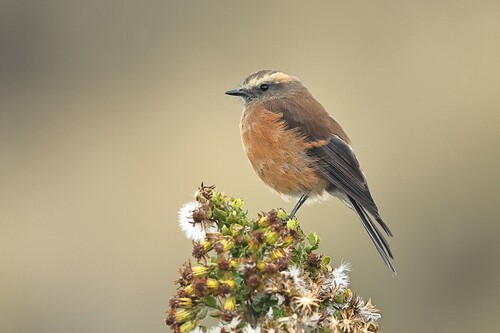
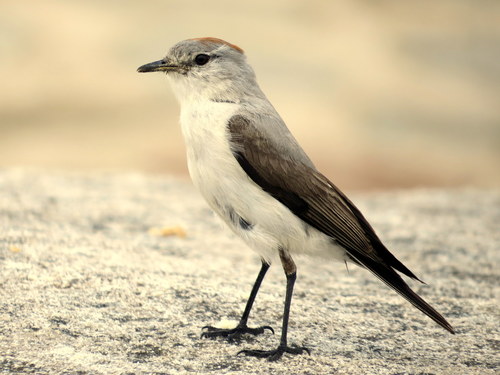
The rufous-naped ground tyrant (scientific name Muscisaxicola rufivertex Orbigny & Lafresnaye, 1837) is 15.5 to 18 cm (6.1 to 7.1 in) long and weighs approximately 19 to 22 g (0.67 to 0.78 oz). Males and females share identical plumage patterns. Adults of the nominate subspecies M. r. rufivertex have a bright cinnamon or orange-rufous patch on the crown, with a faint white supercilium and broken eye-ring on an otherwise pale gray head. Most of their upperparts are also pale gray, with a black lower rump. Their wings are dusky gray, and their tail is dusky with thin white edges on the outer webs of the outermost feathers. Their throat and belly are whitish, and their breast is pale gray. Subspecies M. r. pallidiceps is smaller than the nominate subspecies. It has a paler crown patch, a thinner supercilium, paler ashy gray upperparts, and a blacker tail than the nominate. Subspecies M. r. occipitalis is larger than the nominate, with a rufous crown, slightly darker wings, and a noticeably darker tail. Subspecies M. r. achalensis has a reddish-cinnamon crown, a white supercilium, brown wing coverts, blackish brown primaries and secondaries, and white underparts. All subspecies of the rufous-naped ground tyrant have a dark brown iris, a long thin black bill, and black legs and feet. The rufous-naped ground tyrant has a disjunct distribution, with each subspecies occupying a separate range: M. r. occipitalis is found from Cajamarca Department in north-central Peru south into the La Paz and Cochabamba departments of northwestern Bolivia; M. r. pallidiceps ranges from Arequipa Department in southwestern Peru south through Chile to the Antofagasta Region, and extends through southwestern Bolivia into northwestern Argentina as far as La Rioja Province; M. r. achalensis is restricted to the Sierras de Córdoba in north-central Argentina; and M. r. rufivertex occurs in the Andes of Chile from the Atacama Region to the O'Higgins Region, and extends east into the Mendoza, western Córdoba, and northeastern San Luis provinces of Argentina. This bird inhabits open areas including montane meadows and pastures. It appears to prefer drier areas, as well as rocky outcrops, slopes, ravines, and cliffs. Across its full range, it occurs at elevations between 2,200 and 4,500 m (7,200 and 14,800 ft) during the breeding season, and descends as low as 300 to 1,000 m (1,000 and 3,300 ft) in winter. In Peru, it mostly lives between 2,700 and 4,200 m (8,900 and 13,800 ft), and occurs very locally down to 600 m (2,000 ft) near the southern coast. Subspecies M. r. achalensis is also an elevational migrant: it breeds above 1,600 m (5,200 ft) and winters a little lower than this breeding elevation.