About Muscisaxicola maculirostris Orbigny & Lafresnaye, 1837
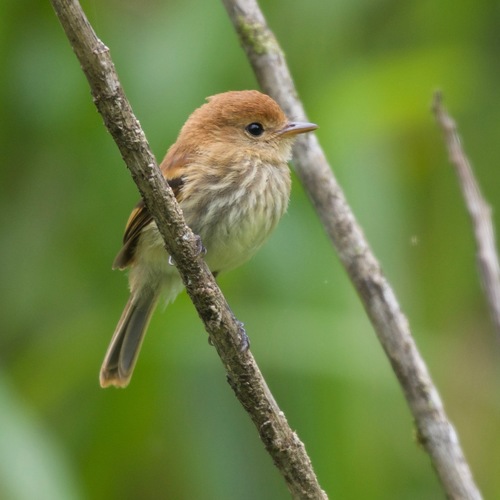
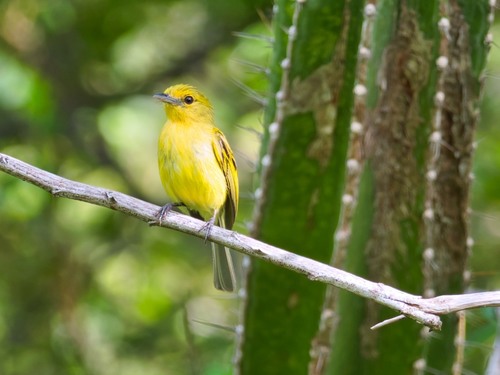
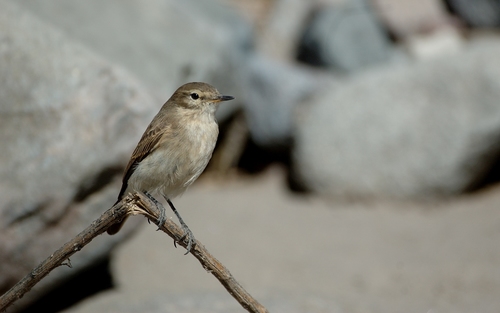
Muscsaxicola maculirostris, commonly called the spot-billed ground tyrant, is 14 to 15.5 cm (5.5 to 6.1 in) long and weighs 11 to 17 g (0.39 to 0.60 oz). Both sexes share identical plumage. Adults of the nominate subspecies have an olive-brown crown, a whitish to buffy white supercilium and a spot above the lores, a dusky line through the eye, and an olive to gray patch on the ear coverts, with the rest of the face ranging from whitish to dusky. Their nape and back are olive-brown. Their wing coverts are olive-brown with buff to rufous edges, and their flight feathers (remiges) are dusky to brownish with thin pale rufous edges. Their tail is dusky brownish to black, with thin whitish or pale yellowish outer edges on the tail feathers. Their chin and throat are whitish; their breast and belly are whitish, with olive mottling or dusky streaking on the breast, and their undertail coverts are whitish to white. As their plumage wears, upperparts fade to grayish and the edges of the wing coverts become paler. This subspecies has a narrow, sharp, medium-length blackish to brownish-black bill, with a conspicuous yellow to orangish yellow base to the lower mandible. They have a dark brown iris and black legs and feet. Juveniles are essentially paler versions of adults, but their wing covert edges are more rusty in color. Subspecies M. m. niceforoi has lighter brown (less olive) upperparts than the nominate, with blackish uppertail coverts. Its breast is slightly buffy, its belly is pale pinkish buff, and its flanks are a slightly darker pinkish buff. Its wings are dark brown, with paler edges on the coverts and remiges. Its tail is blackish with whitish outer edges and blackish tips on the outermost feathers. Subspecies M. m. rufescens is overall more cinnamon to pale rufous in color than the other two subspecies. Its underparts are cinnamon buff, and the inner edges of its remiges are bright ochraceous. The three subspecies of the spot-billed ground tyrant are entirely allopatric, meaning they occupy separate non-overlapping ranges. The nominate subspecies is the southernmost and has by far the largest range. It occurs in the Andes from southern Amazonas and Cajamarca departments in northern Peru south through the rest of the country, reaching the coast in southern Peru. Its range continues through western and central Bolivia and along the full length of the Andes in Chile and Argentina. Subspecies M. m. niceforoi occurs locally along the Colombian Andes from southern Boyacá Department south to Cundinamarca Department and the Bogotá area. Subspecies M. m. rufescens occurs in the Andes of Ecuador from Imbabura Province south to Chimborazo Province, and potentially further south, with one recorded individual in far southern Colombia. The South American Classification Committee of the American Ornithological Society also has records of vagrant individuals of this species in Brazil. The spot-billed ground tyrant inhabits a variety of landscapes, all of which are sparsely vegetated and often rocky. The nominate subspecies occurs from the temperate zone up through alpine areas, most typically on slopes with rock walls and scattered grasses and shrubs. In Argentina, it also occurs around saline lakes. Its elevation range is between 2,000 and 4,500 m (6,600 and 14,800 ft), though it is found mostly between 1,500 and 2,200 m (4,900 and 7,200 ft), and can be as low as 1,000 m (3,300 ft) in Chile and Argentina. Subspecies M. m. niceforoi occurs in dry open landscapes and agricultural areas below the páramo zone, at elevations between 2,000 and 3,400 m (6,600 and 11,200 ft). Subspecies M. m. rufescens inhabits similar open, nearly arid natural and agricultural landscapes, mostly between 2,400 and 3,500 m (7,900 and 11,500 ft).