About Muscisaxicola fluviatilis P.L.Sclater & Salvin, 1866
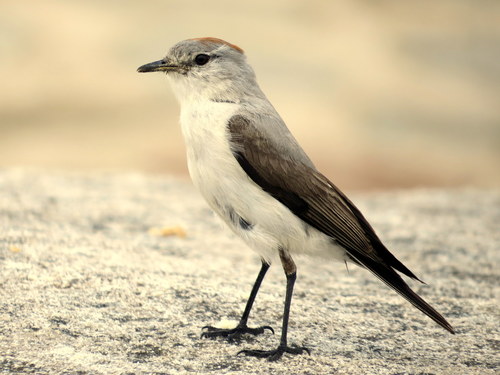
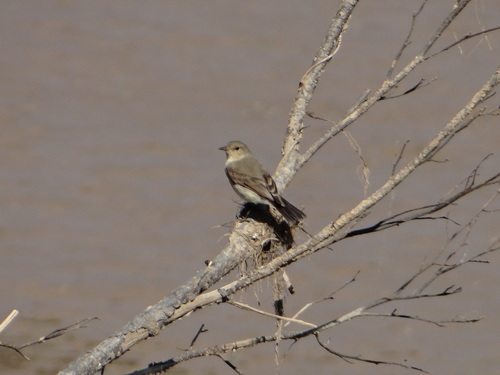
Muscisaxicola fluviatilis, commonly called the little ground tyrant, is 13 to 14 cm (5.1 to 5.5 in) long. Males and females have identical plumage. Adults have a pale buffy supercilium and a matching pale line above their lores. The rest of the face, along with the crown, nape, and back, are grayish sandy brown. Their wings are dusky, with very thin pale grayish cinnamon edges on the inner remiges and small buffy tips on the coverts; these tips sometimes form two visible wing bars. Their tail is black, with white outer webs on the outermost feathers. The throat and breast are buffy white, and the belly is almost white. This species has a dark brown iris, a black bill with a pinkish yellow or orange-yellow base to the mandible, and blackish legs and feet.
In terms of distribution and habitat, the little ground tyrant is found in Peru from the Marañón River to the Inambari River, and extends east into Amazonian Brazil to the upper Madeira River region. Its range stretches south through eastern Peru and across northern Bolivia, well into Brazil's Mato Grosso state. It has occurred as a vagrant in northeastern and far southern Ecuador. In eastern Colombia it is described as "at most very local"; the SACC has no documented records from the country and classifies the species as hypothetical there. The little ground tyrant is essentially terrestrial. It primarily inhabits sandbars and river islands with little vegetation, and sometimes also occurs in nearby open grassy areas. In elevation, it occurs up to 800 m (2,600 ft) in Brazil and 1,500 m (4,900 ft) in Peru. The few records from Ecuador ranged up to 1,150 m (3,800 ft), and records from Colombia only reach 250 m (800 ft). It possibly has been found as high as 3,800 m (12,500 ft) in Bolivia.