About Muscicapa caerulescens (Hartlaub, 1865)
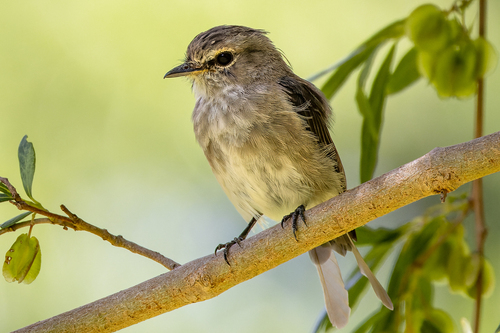
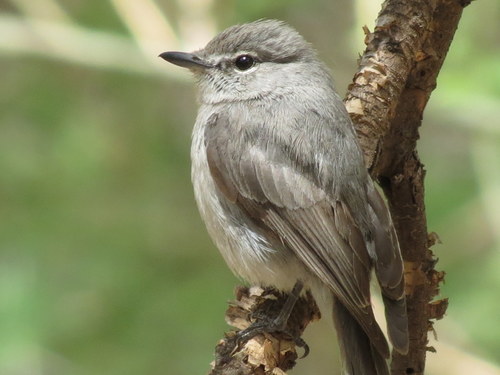
The ashy flycatcher, scientifically named Muscicapa caerulescens (Hartlaub, 1865), measures 13–15 cm (5.1–5.9 in) in length. Adults of the nominate subspecies have bluish-grey crowns and upperparts, very pale grey chins and throats, pale grey breasts and flanks, white bellies and undertail coverts, and grey thighs. They have black loral lines with white stripes above them, plus pale, well-defined eye-rings. Their flight feathers and tail are brownish-black, while their upperwing coverts are brownish-black with grey fringes. The axillaries and underwing coverts are white. The bill is mostly blackish, though the base of the lower mandible is pinkish-grey. The iris is dark brown, and the legs are dark grey or black. Both sexes have identical appearance. Juveniles are brownish, with extensive buff markings on the upperparts, buff tips on the upperwing coverts, and spotted underparts. Immatures are more similar to adults, but still have buff tips on their wing feathers. This species can be easily confused with several other flycatchers that share its range. The grey tit-flycatcher can be told apart from the ashy flycatcher by a combination of its white-edged dark tail and foraging behaviour: the grey tit-flycatcher gleans insects from leaves, while the ashy flycatcher uses the more active method of sallying to catch insects. The African dusky flycatcher is distinguishable by its larger head and more rounded, dumpy appearance, which some observers describe as "cuter". In the east-central part of the ashy flycatcher's range, it may also be confused with the white-eyed slaty flycatcher; the white-eyed slaty flycatcher is usually larger, with a longer tail and a differently coloured bill that is blue at the base and black at the tip. The white-eyed slaty flycatcher also has a more prominent white eye-ring, though the extent of this ring varies between individuals and may not be a reliable identifying feature. The dusky-blue flycatcher, which lives in the same areas as the ashy flycatcher, is generally darker overall, with a particularly dark breast, no eye-ring, and a thicker white stripe above the eyes. The ashy flycatcher is distributed across most of sub-Saharan Africa, ranging from southern Cameroon east through Uganda to southern Kenya and Somalia, and south to Angola, northern Namibia, northern Botswana, and eastern South Africa. It is not found in the arid regions of Namibia, Botswana, and South Africa, and occurs patchily across West Africa, in Sierra Leone, southeastern Guinea, Liberia, Côte d'Ivoire, southern Ghana, southwestern Togo, extreme southern Benin, Burkina Faso, and southern Nigeria. It is mainly a non-migratory resident species, but undergoes limited migration in the southern parts of its range. In South Africa, altitudinal migration has been observed in the Great Escarpment and KwaZulu-Natal. It is also thought to be a non-breeding migrant in Mozambique, the Lebombo Mountains, and the southern Lowveld of Eswatini. This species lives in a variety of forest and woodland habitats. It occurs near forest edges, and only enters closed-canopy forest if the forest has been logged or opened up by roads. It is also found in open gallery forest, secondary growth, riverine strips, and some plantations. It occurs in peanut and cassava fields that have scattered tall trees and shrub or bush borders, as well as in miombo woodland, dense woodland thickets, open riverine woodland, and thornveld and thorn-scrub. It mostly lives at altitudes up to 1,500 m (4,900 ft), but has been recorded at altitudes as high as 1,800 m (5,900 ft) in eastern Africa. In terms of behaviour and ecology, the ashy flycatcher is a restless and active bird that moves and shifts position constantly. It has been observed sunbathing on the ground.