About Muscari comosum (L.) Mill.
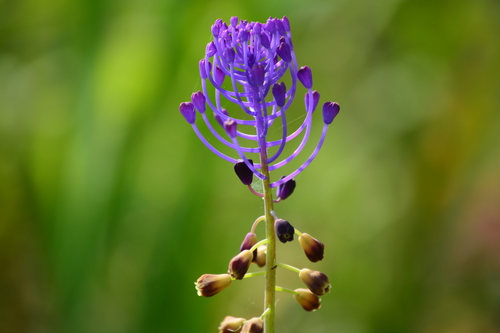
Oleg Polunin described Muscari comosum as a striking plant. It produces a tuft of bright blue to violet-blue sterile flowers above brownish-green fertile flowers, which open from dark blue buds. The overall arrangement of the flowers resembles a menorah candelabrum, and the distinctive upper tuft gives the species its common name of tassel hyacinth. The flower stem of this plant grows between 20 and 60 cm, or 8 and 24 inches, tall. Individual flowers grow on long stalks; the stalks of the sterile upper flowers are purple. Mature fertile flowers are 5 to 10 mm long, with stalks that are at least as long as the flowers themselves. These fertile flowers are bell-shaped and open at the mouth, where paler lobes are present. The leaves are linear, 5 to 15 mm wide, and have a central channel. Muscari comosum naturalizes easily and may become invasive. It has spread northwards from its original distribution, and was recorded growing in the British Isles as early as the 16th century. There is a cultivar of this species called 'Monstrosum' or 'Plumosum', in which all flowers are modified into branched purple stems.