About Muscari armeniacum H.J.Veitch
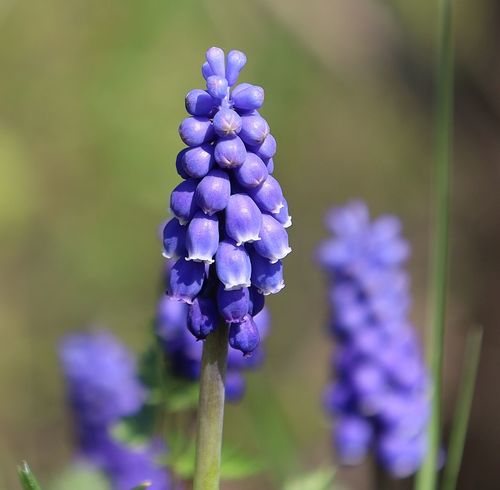
Muscari armeniacum H.J.Veitch, commonly called Armenian grape hyacinth or garden grape-hyacinth, is one of the flowering plant species known as grape hyacinth. It belongs to the squill subfamily Scilloideae of the asparagus family Asparagaceae; it was previously classified in the lily family Liliaceae. This species is a bulbous perennial that produces simple basal leaves and short flowering stems. Plants of this species usually grow 15 centimetres (6 inches) tall. Their flowers may be purple, blue with a white fringe, white (the cultivar 'Album'), or pale pink (the cultivar 'Pink Sunrise'). M. armeniacum blooms for 3 to 4 weeks in mid-Spring, which corresponds to April or May in the Northern Hemisphere. Some cultivated selections have fragrant blooms. Established bulbs produce new leaves in the autumn. This species grows widely in woods and meadows of the Eastern Mediterranean, ranging from Greece and Turkey to the Caucasus; it takes its name from Armenia, which is included in its native range. Muscari armeniacum is one of the most commonly cultivated species of the Muscari genus. It is a robust plant that naturalises easily, and it was first introduced to European gardens in 1871. Multiple cultivars of this species have earned the Royal Horticultural Society's Award of Garden Merit. Cultivars listed by Mathew include 'Blue Spike' and 'Cantab'. Other awarded cultivars are 'Argaei Album', 'Album' (white-flowered), 'Côte d'Azur', 'Dark Eyes', 'Early Giant', 'Fantasy Creation', 'Peppermint', 'Saffier', 'Valerie Finnis' (pale blue-flowered), and 'Pink Sunrise' (pale pink-flowered). The common widely available form is often labelled M. armeniacum 'Blue'. 'Blue Spike' is a double-flowered variety that bears double florets along its flower stalk. 'Cantab' produces pale blue flowers. 'Fantasy Creation' is a sport, a naturally occurring genetic mutation, derived from 'Blue Spike'. 'Atlantic' is a light blue cultivar, introduced by Jan van Bentem in 2002; it was created via hybridisation in 1990, using M. armeniacum and an unknown parent plant.