About Musanga cecropioides R.Br. ex Tedlie
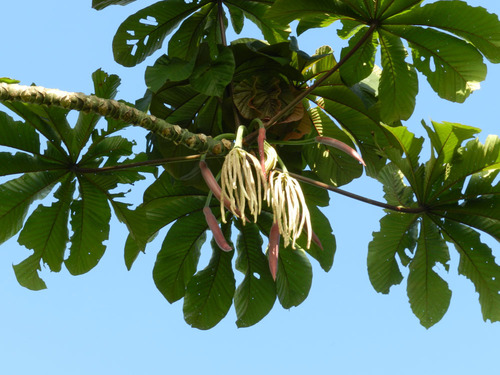
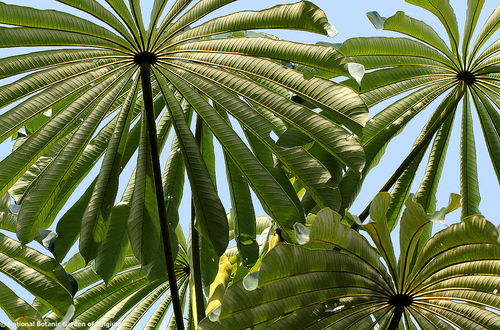
Musanga cecropioides can grow to a height of 45 metres (148 ft), with a trunk diameter reaching up to 50 centimetres (20 in). Its trunk is pale whitish-yellow, with a rough, granular texture. Its leaves consist of palmately arranged leaflets, with up to twenty-six leaflets per leaf, forming an eccentric circle up to 110 cm (43 in) in diameter. The lowest, largest leaflet can grow up to 75 cm (30 in) long and 15 cm (5.9 in) wide. Musanga cecropioides is a pioneer species that readily grows in newly cleared patches of forest. In these locations in Nigeria, it is found alongside poison devil's-pepper (Rauvolfia vomitoria), Ivory Coast almond (Terminalia ivorensis), and dragon's blood tree (Harungana madagascariensis). After five years of growth, M. cecropioides becomes the dominant species, forming a closed canopy at 10 m (33 ft). This species, commonly called African corkwood tree, has wood that is used to make flotation devices like rafts, as well as toys. Its wood has a soft, weak structure, and tends to develop mold and discolor easily. Musanga cecropioides is also used in traditional medicine by Bantu peoples in the Central African Republic, Gabon, and Equatorial Guinea.