About Muraltia heisteria (L.) DC.
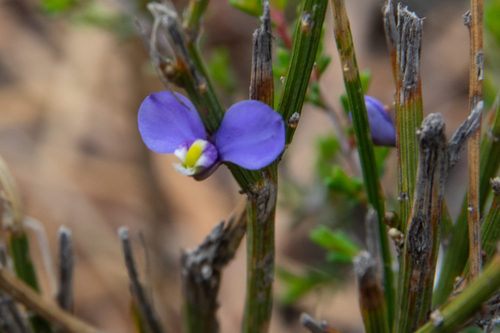
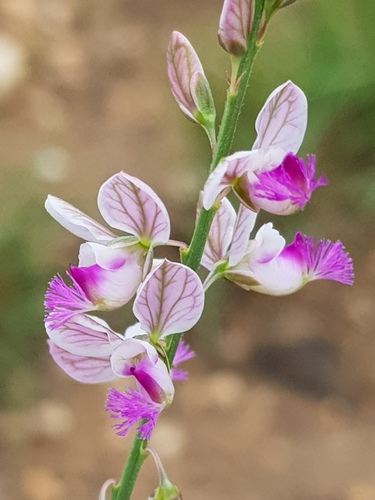
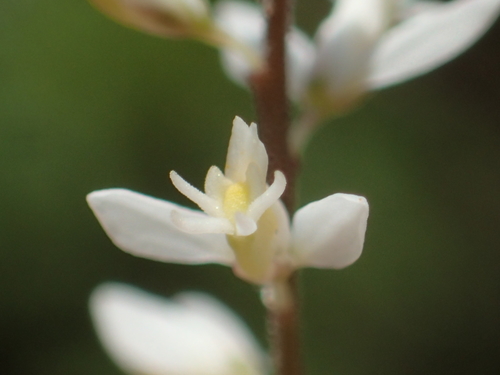
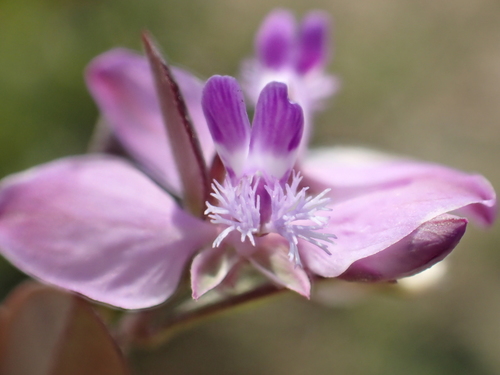
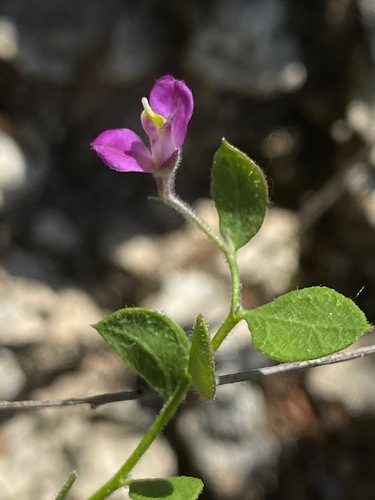
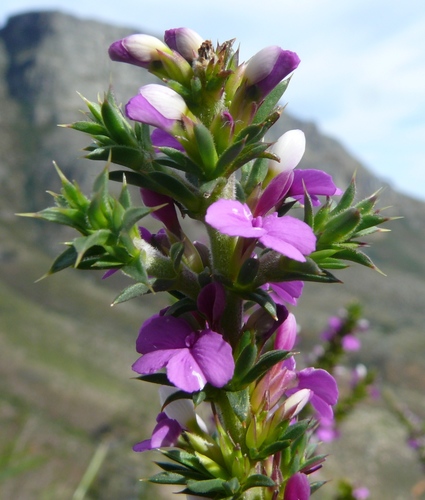
Muraltia heisteria (L.) DC. is a very prickly, rigid erect perennial shrub or dwarf shrub. The species has both sparse and dense branching, and grows 20 to 80 centimetres (0.66 to 2.62 ft) tall. Its hard, thick leaves are lance-shaped, end in a sharp spine tip, and usually have hairy margins. The leaves grow in clusters along stems, measuring 5 to 10 millimetres (0.20 to 0.39 in) long and 1 to 2 millimetres (0.039 to 0.079 in) wide. This plant produces small purple, pink, or rarely white flowers, which are thickly distributed along the branches and measure 7 to 12 millimetres (0.28 to 0.47 in) long. It has 5 almost equally sized sepals that are 4 to 5 millimetres (0.16 to 0.20 in) long, and 3 petals that are 8 to 10 millimetres (0.31 to 0.39 in) long. It is native to lower rocky mountain slopes at altitudes ranging from 5 to 1,705 metres (16 and 5,594 ft) in South Africa's Eastern Cape, Northern Cape, and Western Cape provinces, and has been introduced to South Australia, New South Wales, and Victoria in Australia. This species is capable of natural self-pollination. In its native range, it flowers from October to December, while in Australia it flowers from June to November. It acts as a host plant for the insect Pseudococcus muraltiae. Per the Red List of South African Plants, Muraltia heisteria is classified as least ecological concern, and its overall population is stable. Local people use the plant's flowering twigs as an appetite stimulant, and the species is cultivated in Australia.