About Munzothamnus blairii (Munz & I.M.Johnst.) P.H.Raven
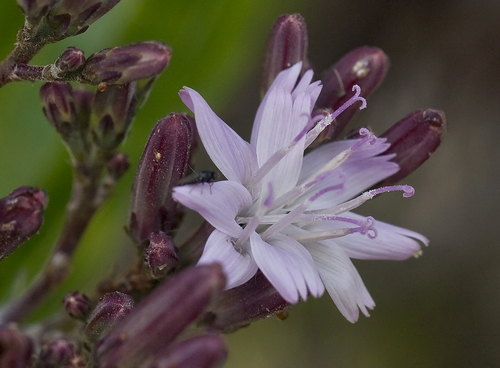
Munzothamnus is a monotypic genus of flowering plants in the family Asteraceae. It contains only one species: Munzothamnus blairii, commonly called Blair's wirelettuce or Blair's munzothamnus. This species is endemic to San Clemente Island, one of California's Channel Islands, where it grows along steep, rocky cliffsides and within canyons. It is a shrub that produces a fleshy, woolly stem, usually growing over one meter in height and often approaching two meters tall. Leaves grow in tufts at the ends of the stem branches. They are oblong in shape, up to 15 centimeters long, and sometimes bear very shallow lobes. Young leaves are woolly, but they lose their hairs and become shiny green as they age. The inflorescence is a large array holding up to 35 flower heads. Each head has a cylindrical base less than one centimeter long, and contains 9 to 12 light lavender or pinkish flowers. Each flower is a ray floret with an erect tube and a strap-shaped ligule that has a toothed tip; the ligule itself measures just under one centimeter long. The fruit is a cylindrical, ribbed achene topped with a white pappus. Like many endemic plant species of the Channel Islands, this plant became rare due to the presence of feral goats on the island; the goats have since been removed. The genus name Munzothamnus honors the American botanist Philip A. Munz.