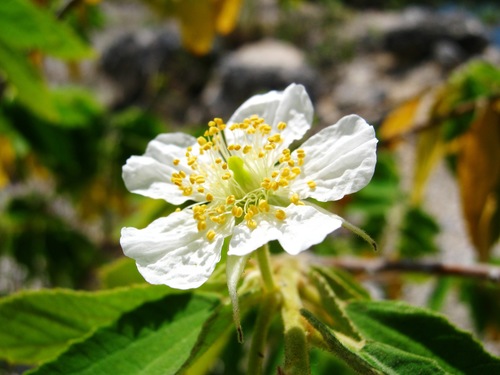
About Muntingia calabura L.
Muntingia calabura L. is a fast-growing shrub or tree that reaches 7.5 to 12 m in height, with spreading branches. Its leaves are alternate, distichous, oblong or lanceolate, measuring 4 to 15 cm long and 1 to 6 cm wide. They have toothed margins and are covered in short hairs. The small flowers, up to 3 cm wide, grow either alone or in inflorescences of two or three flowers. Each flower has five hairy lanceolate sepals, five obovate white petals, many stamens with yellow anthers, and a smooth ovoid ovary. Flowers last only one day, and their petals drop in the afternoon. The fruit is an edible berry around 1.5 cm in diameter, with smooth, thin skin. Unripe fruits are green, and they turn red when mature. The pulp is light-brown, juicy, contains very fine seeds, and has a flavor similar to fig. M. calabura is native to southern Mexico, the Caribbean, Central America, and western South America, ranging south to Bolivia and Argentina. It grows in tropical climates in disturbed lowland areas, from sea level up to 1000 m in elevation. In South India, it occurs in areas adjacent to the Western Ghats. This species colonizes disturbed tropical lowland habitats, where it becomes part of secondary vegetation and gallery forests. It grows well in poor soil, and can tolerate acidic, alkaline conditions and drought, but cannot grow in saline conditions. Its seeds are dispersed by birds and fruit bats. Although native to tropical America, M. calabura has been introduced to Southeast Asia, where it has naturalized, and also occurs in other tropical regions around the world. M. calabura is planted for timber and fuel. Its soft wood is used for rural construction, while its fibrous bark is used to make ropes. The fruits are edible and sometimes sold in markets; they can be eaten raw or processed into jam. Leaves can be used to make tea. Traditional medicinal uses have been reported for different parts of the plant: leaves are used to treat headaches, prostate problems, and gastric ulcers; bark is used as an antiseptic; flowers are used as an antiseptic, to reduce swelling, and as an antispasmodic; fruits are used for respiratory problems and as an antidiarrheic. It is reported to help diabetic patients, and a small reduction in patients' blood sugar levels has been recorded after consumption. It is planted as an ornamental species, for shade, and because its flowers provide nectar and pollen for the beekeeping industry. In Brazil, it is also planted along river banks, since fallen fruits attract fish. M. calabura has potential as a useful species for restoring disturbed areas and preventing soil erosion. It also provides shelter for wildlife, and acts as a food source for around 60 species of birds and mammals. M. calabura can be propagated from seed, seedlings, or cuttings. In Costa Rica, seeds are produced in the wet season, and require the specific light and temperature conditions found in forest gaps to grow. In one experiment, seeds were placed on wet paper towel held at 25 °C and exposed to different lighting conditions: 44% of seeds germinated under white light, while no seeds germinated in the dark.

