About Mungos mungo (Gmelin, 1788)
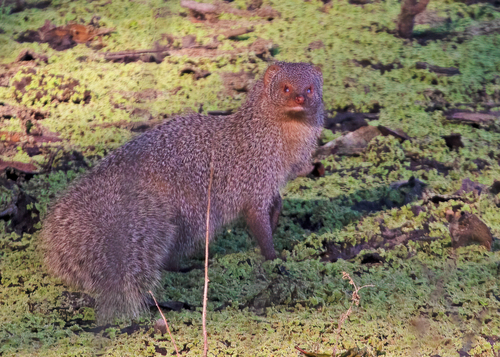
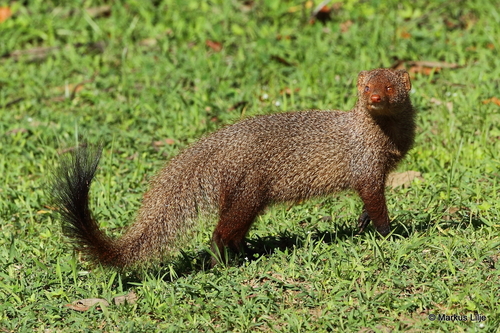
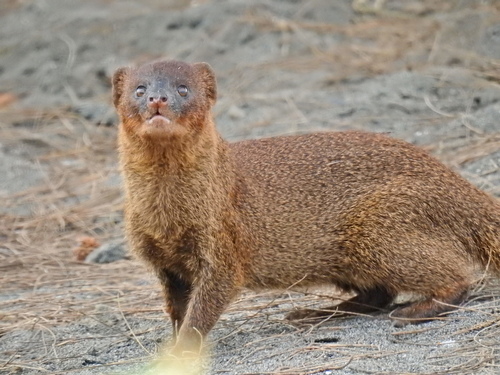
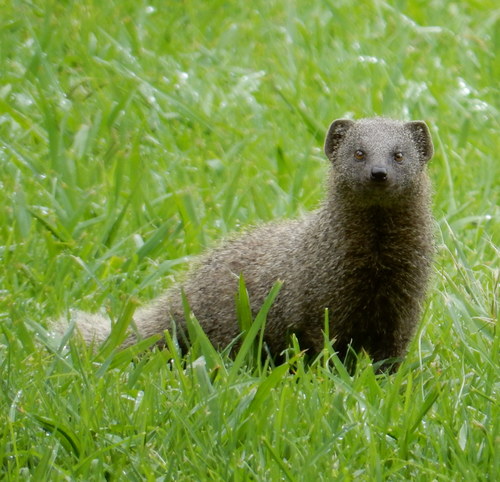
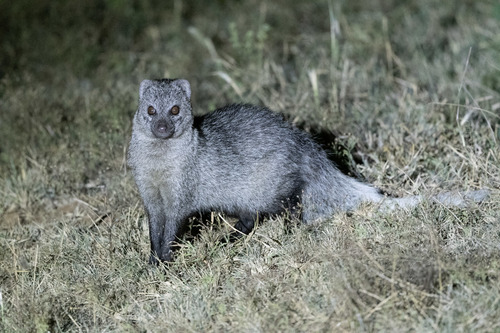
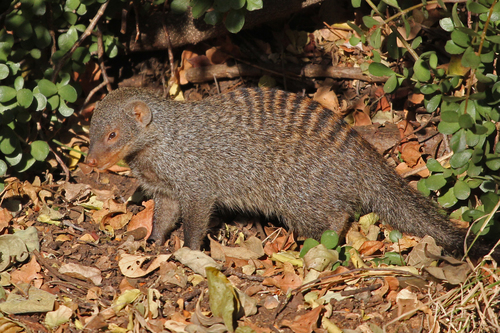
The banded mongoose, with the scientific name Mungos mungo (Gmelin, 1788), is a sturdy species of mongoose. It has a large head, small ears, short muscular limbs, and a long tail that is almost as long as the rest of its body. Individuals from wetter regions are larger and darker in color than those from drier regions. Its abdomen is higher and rounder than its breast area. The species' rough fur is grayish brown and black, marked with several dark brown to black horizontal bars across the back. Its limbs and snout are darker than the body, while its underparts are lighter than the rest of the body. Banded mongooses have long, strong claws that allow them to dig into soil. Their nose color ranges from gray-brown to orange-red. Adults reach a total body length of 30 to 45 cm, a weight of 1.5 to 2.25 kg, and a tail length of 15 to 30 cm.
The banded mongoose is distributed across a large portion of East, Southeast, and South-Central Africa, with additional populations in the northern savannas of West Africa. It inhabits savannas, open forests, and grassland, especially areas near water, and also lives in dry, thorny bushland, but does not occur in deserts. The species uses various types of dens for shelter, most commonly termite mounds. It will also shelter in rock formations, thickets, gullies, and warrens under bushes. Banded mongooses prefer multi-entranced termite mounds located beside open thicket, an average of 4 meters from the nearest shelter, in semi-closed woodland. Compared to dwarf mongoose dens, banded mongoose dens are less dependent on vegetation cover and have more entrances. Since banded mongooses live in larger groups than dwarf mongooses, more entrances give more group members access to the den and improve ventilation. The banded mongoose occurs in many African protected areas. Population density is around three individuals per square kilometer in Tanzania's Serengeti, and 2.4 individuals per square kilometer in southern KwaZulu-Natal, with a much higher density of 18 individuals per square kilometer in Queen Elizabeth National Park.
Banded mongooses live in mixed-sex groups of 5 to 75 individuals, with an average group size of around 20 individuals. Groups sleep together overnight in underground dens, most often abandoned termite mounds, and change dens frequently, every 2 to 3 days. When no refuge is available and the group is pressured by predators such as African wild dogs, the group forms a compact arrangement, with members lying on top of each other and all heads facing outwards and upwards. There is generally no strict social hierarchy in banded mongoose groups. Most aggression and hierarchical behavior occurs between males when females are in oestrus. Males perform mate-guarding of females in the group and attempt to control reproduction, but this practice is only minimally successful, as females tend to work against the mate-guarding male by actively seeking extra-pair copulations. Older females have earlier oestrus periods and produce larger litters. They are more desirable to males and are the first to be mate-guarded. When groups grow too large, some females are forced out of the group by either older females or males. These expelled females may form new groups with subordinate males. Relations between different groups are highly aggressive, and mongooses are sometimes killed or injured during intergroup encounters. Despite this, breeding females often mate with males from rival groups during these fights. Banded mongooses mark their territories with scent markings, which also serve as communication between members of the same group.
Unlike most other social mongoose species, all females in a banded mongoose group can breed. All females enter oestrus around 10 days after giving birth. Dominant males monitor females and aggressively defend them from subordinate males. While dominant males perform most of the mating, females often try to escape from them and mate with other males in the group, meaning dominant males do not have full control over females' mating choices. A dominant male spends 2 to 3 days guarding each female, and will snap at, lunge at, or pounce on any other male that approaches. Gestation lasts 60 to 70 days. In most breeding attempts, all females give birth either on the same day or within a few days. Litters range from two to six pups, with an average of four. For the first four weeks of life, pups stay in the dens. Many pups form an exclusive relationship with a single helper or escort, whose genetic relationship to the pup is unknown. These helpers are generally young nonbreeding males or breeding females that have contributed pups to the current litter, and they help minimize competition over food allocation among pups. During this period, helpers guard the pups while other group members go foraging. After four weeks, pups are able to forage on their own. Each pup continues to be cared for by a single adult "escort" that helps the pup find food and protects it from danger.