About Muhlenbergia rigens (Benth.) Hitchc.
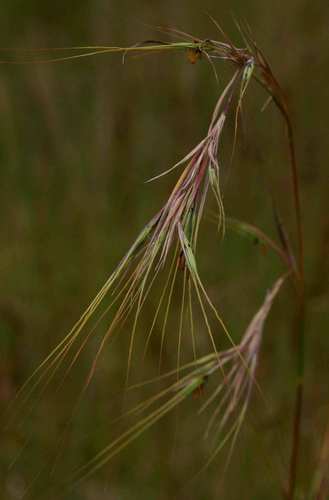
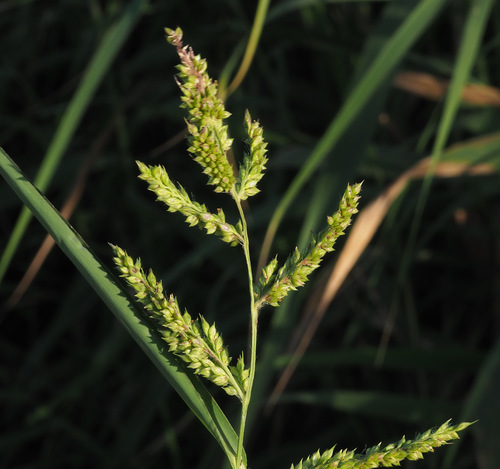
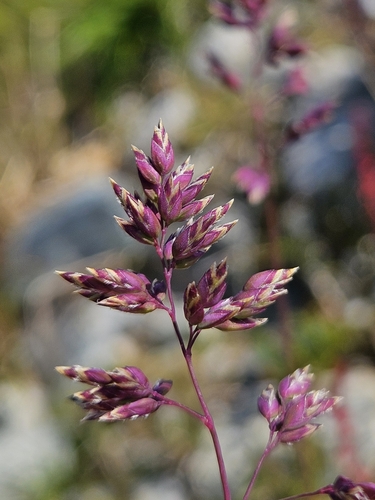
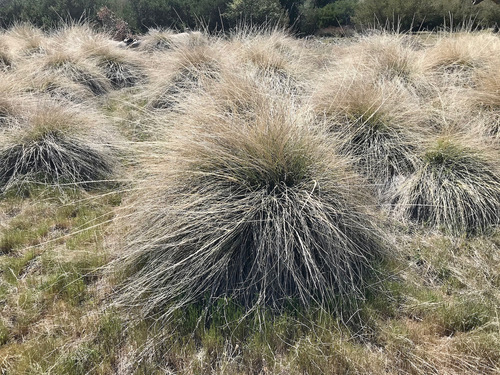
Muhlenbergia rigens, commonly called deergrass, is defined by dense, tufted basal foliage made up of narrow pointed leaves that grow to around 3 feet (0.91 m) long. Foliage color ranges from light silver-green to purple. Its spikelike stems are less than half an inch wide and 3–4 feet (0.91–1.22 m) long. When in bloom, its many-flowered panicles often reach a total height of five feet. Its spikelets each contain a single awnless floret with a 3-nerved lemma. This grass is native to a range that extends north to Shasta County, California, and south to New Mexico, Texas, and Mexico. Within this range, it grows across a wide variety of ecotypes, including grassland, riparian, chaparral, mixed conifer, and oak woodland communities. Deergrass can grow in areas that experience periodic flooding, but it cannot tolerate standing water or poorly drained soils. It prefers full sun but is able to tolerate shade. Deergrass can be established in late spring and early summer via broadcast seeding with irrigation. For the best results, plant 50 seeds per square foot, then lightly incorporate them just below the soil surface with a culti-packer. Establishment is most successful when actions are taken to limit weed growth. Burning, discing, and reduced fertilization plans to lower the weed seed bank are recommended. Container planting is a very effective method for establishing deergrass. Seed can be sown in flats in May and transplanted in the fall of the same year. In California, outside of areas with heavy frost, deergrass can be planted successfully in winter and spring to benefit from seasonal rainfall. Stand preparation is the same as for broadcast seeding. When transplanting, plants should be spaced at least two feet apart. After establishment, very little management is needed. Irrigation is not required in years with normal rainfall, and fertilization is not recommended because it can increase weed competition. Burning or mowing can be done every few years to remove accumulated dead plant material. Since Muhlenbergia rigens uses C4 carbon fixation, it has an advantage in drought and high temperature conditions. This trait, along with its attractive appearance, has recently drawn attention to the species as an ornamental plant for xeriscape gardens. Studies have also shown that the species has high salt tolerance, suggesting it could be irrigated with low-quality reclaimed wastewater at very low cost. Ecologically, deergrass provides cover for mule deer during fawning seasons. Studies have linked reduced deer populations to overgrazed deergrass stands in and near cattle pasture. Young shoots and leaves are grazed by deer, horses, and cattle. It serves as an overwintering host for many species of Lepidoptera and ladybugs. Deergrass seed provides food for many different bird species. In terms of uses, young shoots are eaten by a range of animals, but the plant becomes unpalatable as it ages. Because of this, it is useful in exposed garden settings for its deer resistance. It has also been used for erosion prevention and streambank stabilization due to its extensive root systems. Current restoration projects use deergrass to outcompete exotic invasive annual plants that dominate some grassland ecosystems. Deergrass can also be used to remediate overtilled, eroded agricultural land, where it anchors soil and returns lost organic matter to the soil. Phytoremediation studies have tested deergrass's ability to remove chemicals from agricultural runoff. Its dense stands and extensive roots work as a biofilter that is effective at breaking down herbicides, pesticides, and particulates. Among the Zuni people, the grass is attached to plume offering sticks for anthropic gods.