About Muehlenbeckia astonii Petrie
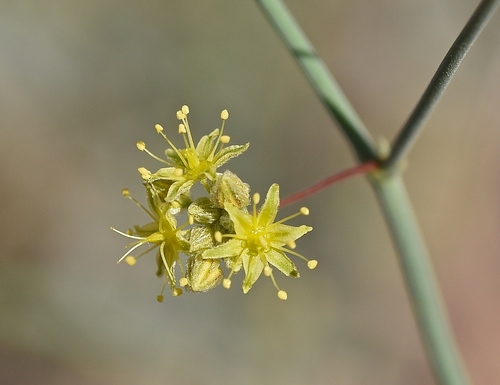
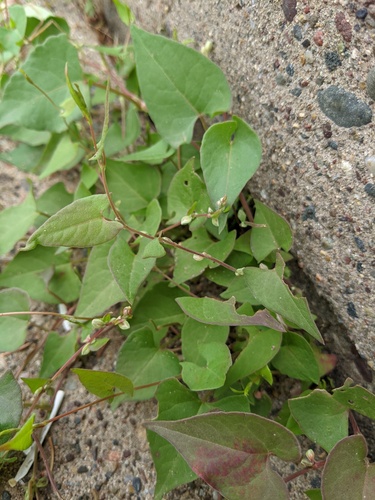
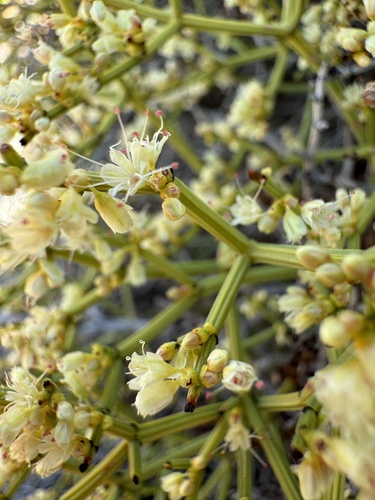
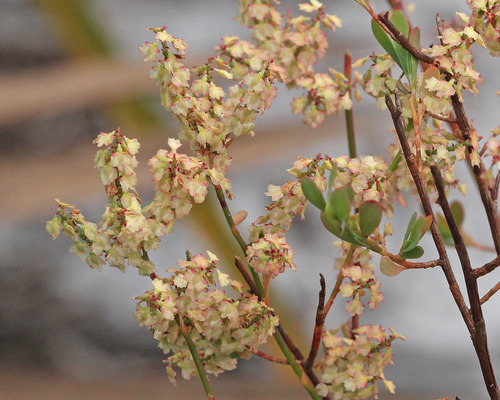
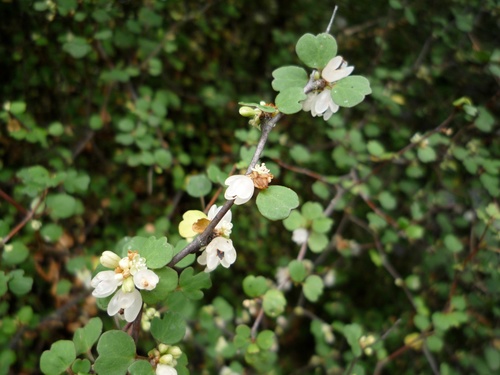
Muehlenbeckia astonii Petrie, commonly called shrubby tororaro, has very small leaves, which are 2–15 mm wide and grow on 3–10 mm brown stalks. Leaves grow in clusters of two to three, sometimes five, or alternate along longer branchlets. They are typically heart-shaped with a notched tip, bright green on the upper surface and pale on the lower surface. Unlike most New Zealand native plants, M. astonii loses its leaves in winter. It grows from a distinct trunk, producing many fine flexible reddish brown to orange branches that zigzag around one another to form a dense, interwoven rounded bush. These bushes generally measure 2–3 meters across, and can reach 4 × 4 meters in size. Older plants develop cane-like stems from their interior, and individuals have been recorded living for more than 80 years. Tiny flowers appear from December to January, growing in clusters of two to four, and are less than 10 mm in diameter. Flower color ranges from greenish to white or pinkish white. This species is gynodioecious: individual plants bear either female flowers, or 'inconstant male' hermaphrodite flowers. Inconstant males are capable of self-fertilization, but their seeds have less than 5% viability. Isolated female plants produce infertile fruit, or hybridize with nearby Muehlenbeckia species. Fruits develop from October to June. The seed is a dull, dark three-sided nut 2–2.5 mm long; its dull non-glossy texture distinguishes it from the seed of M. complexa, scrub pōhuehue. The seed is surrounded by swollen remnants of tepals that form a white fleshy fruit within just 10–15 days. This fruit is sugary and edible; birds and lizards eat the fruit and disperse the seeds, while mice eat the fruit and pulverize and kill the seeds. Seeds can remain viable for up to four years when stored in soil. M. astonii is an important host plant for several endemic New Zealand moth species, and is the sole host for some of these species. This species was likely once widely distributed across drier lowland and coastal areas of eastern New Zealand, particularly on terraced riverbeds, and probably ranged as far south as the Waitaki Valley in South Canterbury. Its former full range is difficult to determine, since botanists did not formally recognize the species until decades after most of New Zealand's dry scrublands were cleared for agriculture. M. astonii has a deep root system that helps it survive dry conditions, and it can grow on open rocky hillsides and stony ground up to 300 meters in altitude. It prefers free-draining, warm, sunny slopes on moderately to highly fertile soil. Currently, M. astonii is only found in four regions of New Zealand: around Palliser Bay at the southern tip of the North Island, from Honeycomb Light south to Sinclair Head; northeastern Marlborough, only in the lower Awatere Valley, Blind River, Clifford Bay, and Cape Campbell; multiple sites in North Canterbury discovered in the 1950s and 1960s, including Balmoral, Weka Pass, Waikari Stream, Waiau, and along the Waipara River; and Kaitorete Spit at Lake Ellesmere (which holds 90% of the species' entire global population), plus Birdling's Flat and Lake Forsyth at the southwestern edge of Banks Peninsula. M. astonii is usually deciduous, though it retains some leaves when grown in northern New Zealand. It prefers dry conditions and is very drought tolerant; excess moisture causes root rot in this species. Its unusual growth form and wiry orange stems make it a popular interesting garden plant. It tolerates light shade, but grows well as a shelter plant in exposed sites, and can withstand salt spray, wind, and frost. It can be planted as an informal hedge, and responds well to pruning into shape. When planted in rich soil, M. astonii grows vigorously upward and may require staking. It can be propagated from winter hardwood cuttings, which root best when taken in early spring, and also grows well from outcrossed seed. Its translucent decorative fruits mean that most plants sold in nurseries are female. When only 48 wild M. astonii were known to remain in the Wellington area, the Hutt Valley and Wellington city councils began propagating wild-collected plants, growing males and females from different wild populations close together on traffic islands where they could pollinate one another. Cuttings taken from these established traffic island populations were used to produce 1500 new plants, which were subsequently planted in Turakirae Reserve, where the species originally occurred.