About Mucuna urens (L.) Medik.
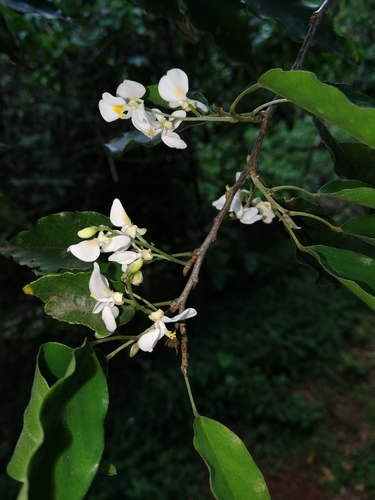
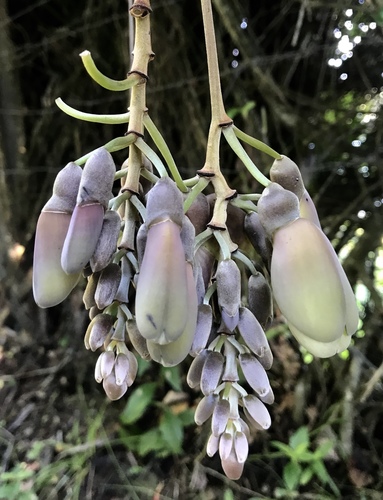
Mucuna urens (L.) Medik. is a large, vigorous, much-branched twining liana that climbs into tree canopies. Its stems are thick and soft, and bear alternate trifoliate leaves with petioles that can grow up to 15 cm (6 in) long. The leaflets are ovate or elliptical, reaching up to 15 cm (6 in) long; lateral leaflets are somewhat oblique, and all leaflets have rounded bases and apiculate tips. Inflorescences grow laterally or in leaf axils, forming pendulous racemes with peduncles up to 1 metre long, with flowering occurring near the tip. The calyx has a 1 cm (0.4 in) long tube, and the petals are thick, waxy, and yellowish. The standard petal is slightly longer than the wings and keel. After flowering, the plant produces transversely-ridged, oblong pods measuring about 15 cm × 5 cm (6 in × 2 in). These pods are covered in orange-brown bristly stinging hairs, have a suture along their underside, and feature two longitudinal undulating wings. Each pod holds 1 to 4 rounded seeds that are at least 2.5 cm (1 in) in diameter, with a hilum that almost completely surrounds the seed. This liana is native to the West Indies, Central America, and South America, with its natural range extending from Panama to Peru, Ecuador, Bolivia, and Brazil. It grows in forests and woodland at altitudes up to 1,800 m (6,000 ft). Mucuna urens is used in traditional medicine. A tincture made from powdered bean macerated in alcohol is used as a soothing remedy for hemorrhoids, especially those that tend to bleed. The stinging hairs from the pods can be taken internally to expel live intestinal worms. These stinging hairs are irritating to the skin: contact causes intense itching, reddening, and formation of tiny pustules soon after exposure, caused by the active proteolytic enzyme mucunain. Potable water can be obtained from the plant's fleshy stems. Fibres from the stem are used to make strong rope. The seeds are used to make beads and ornaments, and also serve as famine food. When a seed extract was given to male guinea pigs at low dosages, it was found to cause sperm degeneration, raising the possibility that this plant could be used as a male anti-fertility agent.