About Mucuna pruriens (L.) DC.
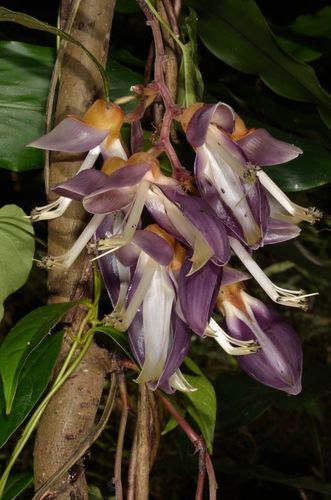
Mucuna pruriens (L.) DC. is an annual climbing shrub with long vines that can reach over 15 metres (50 feet) in length. Young plants are almost completely covered in fuzzy hairs, while older plants are almost entirely hairless. Its leaves are tripinnate, and can have an ovate, reverse ovate, rhombus-shaped or widely ovate form. Leaf sides are often heavily grooved, and leaf tips are pointed. Both sides of leaves bear hairs on young specimens. Leaflet stalks measure 2–3 millimetres (1⁄16–1⁄8 inch) long, and additional adjacent leaves are present, growing about 5 mm (1⁄4 in) long. Flower heads form axially arranged panicles that are 15–32 centimetres (6–13 in) long, holding two, three, or many flowers that may be white, lavender, or purple. Accompanying leaves are about 12.5 mm (1⁄2 in) long, while inflorescence axes range from 2.5–5 mm (1⁄8–3⁄16 in). The corolla tube is 7.5–9 mm (5⁄16–3⁄8 in) long and has a silky texture. Sepals are longer than or the same length as the staminal tube. The corolla is either purplish or white. The standard petal is 1.5 mm (1⁄16 in) long, while the wing petals are 2.5–3.8 cm (1–1+1⁄2 in) long. When fruit ripens, it develops into an unwinged, leguminous pod 4–13 cm (2–5 in) long and 1–2 cm (3⁄8–3⁄4 in) wide. A ridge runs along the length of the pod, and its husk is covered in loose, orange hairs that cause severe itching if they contact skin. Pods can hold up to seven seeds, which are shiny black or brown flattened uniform ellipsoid drift seeds. Seeds measure 1–1.9 cm (3⁄8–3⁄4 in) long, 0.8–1.3 cm (3⁄8–1⁄2 in) wide, and 4–6.5 mm (1⁄4–1⁄4 in) thick. The hilum, the base of the funiculus that connects the placenta to the seed, is surrounded by a prominent fleshy arillus. 100 dry seeds weigh 55–85 grams (2–3 ounces). Mucuna pruriens is used as an important forage, fallow and green manure crop across many parts of the world. As a legume, it fixes nitrogen to fertilize soil. In Indonesia, particularly on Java, the beans are eaten and are widely known as 'Benguk'. Beans can also be fermented to make a tempeh-like food called Benguk tempe or 'tempe Benguk'. It is a widespread fodder plant in the tropics; the whole plant is fed to animals as silage, dried hay or dried seeds. Mucuna pruriens silage contains 11–23% crude protein and 35–40% crude fiber, while dried beans contain 20–35% crude protein. It is also used as a biological control for problematic Imperata cylindrica grass in Benin and Vietnam. Mucuna pruriens is reported to not be invasive outside of its cultivated area, but it is invasive within conservation areas of South Florida, where it frequently invades disturbed land and rockland hammock edge habitats. Cooked fresh shoots or beans can also be eaten. The plant contains relatively high levels of l-DOPA at 3–7% dry weight; some people have sensitivity to this compound, which can cause nausea, vomiting, cramping, arrhythmias, and hypotension. The plant and its extracts have long been used in tribal communities as an antidote for snakebite. In modern research, its effects against bites from cobras (Naja), saw-scaled vipers (Echis), Malayan pit vipers (Calloselasma), and kraits (Bungarus) have been studied. The dried leaves of Mucuna pruriens are sometimes smoked.