About Mucuna gigantea (Willd.) DC.
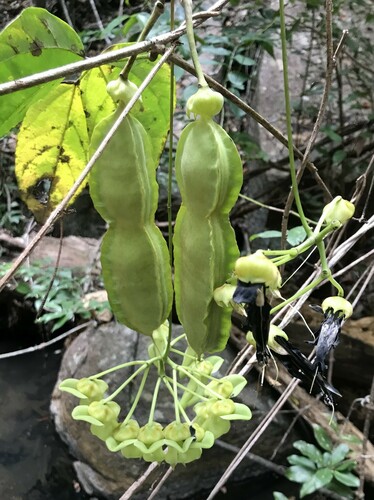
Mucuna gigantea (Willd.) DC. is a large woody twining climber with a stem diameter reaching up to 10 cm (3.9 in). It typically grows to around 30 m (98 ft) in length, and may reach a maximum length of 80 m (260 ft). New growth is covered in orange-brown hairs, while mature sections of the stem are glabrous, marked with dark, raised lenticels, and the stem may have an irregular shape. The alternately arranged trifoliate leaves attach to twigs via petioles that grow up to 15 cm (5.9 in) long, and the base of each petiole swells into a pulvinus. The central leaflet is elliptic to ovate, the two lateral leaflets are oblique (asymmetric), and all leaflets grow up to 15 cm (5.9 in) long and 8 cm (3.1 in) wide. All leaflets have rounded bases and acuminate to apiculate tips, with 4–6 pairs of lateral veins on either side of the midrib. Inflorescences form in leaf axils as pendulous, umbel-like clusters growing on long branched peduncles that measure between 8 and 25 cm (3.1 and 9.8 in) long. Individual flowers sit on short lateral stalks. Each flower has a cup-shaped, two-lipped calyx covered in fine greyish hairs. Corolla lobes are white, pale-green or pale lilac; the standard petal is up to 3.5 cm (1.4 in) long, with the wings and keel being slightly longer. Most parts of the inflorescence are covered in fine pale hairs. Dark brown oblong pods (fruits) grow up to 15 cm (5.9 in) long, 5 cm (2.0 in) wide and 2 cm (0.79 in) thick, and are covered in brown or golden irritant hairs. They are nearly rectangular in cross-section, with short wings about 5 mm (0.20 in) wide at each corner. Pods usually hold 1 to 4 dark brown or black seeds that are disc-shaped but not regularly rounded, measuring around 25–30 mm (0.98–1.18 in) in diameter and about 6–10 mm (0.24–0.39 in) thick. A very prominent hilum extends around three-quarters of the seed’s perimeter. Seeds can be carried long distances by sea currents, which gives this species a near pan-tropical distribution. Germination in this species is hypogeal, meaning the cotyledons remain below the soil surface. The first true leaves are scale-like, and growth is very rapid: plants can reach a height of one metre or more in three weeks. The plant’s tissues are easily damaged, and even its flowers turn black when injured. Mucuna gigantea occurs in tropical Africa, southwestern and southern Asia, and Oceania. In Africa, its range extends from the Republic of Congo to Kenya, Tanzania and Madagascar. In Asia, it can be found in India, Myanmar, Malaysia, Thailand and the Philippines. In Oceania, it is present in New Guinea, the Australian states of Western Australia, the Northern Territory, Queensland and New South Wales, and numerous Pacific islands. Its natural habitat includes beach forest, monsoon forest, and lowland and upland rainforest. In Africa, it also grows inland near large watercourses and lakes. After suitable preparation, the seeds of Mucuna gigantea are eaten in Kenya and India. Aboriginal Australians bake the seeds on hot stones, remove the skins, grind them into flour, mix the flour with water, wrap the dough in leaves, and bake it a second time. An extract of the root has been used to treat schistosomiasis and gonorrhea, and powdered seeds have been used as a laxative. The intensely irritating hairs from the pods have been used as poison in Malaysia, and mixed with food to control rats.