About Mucronea californica Benth.
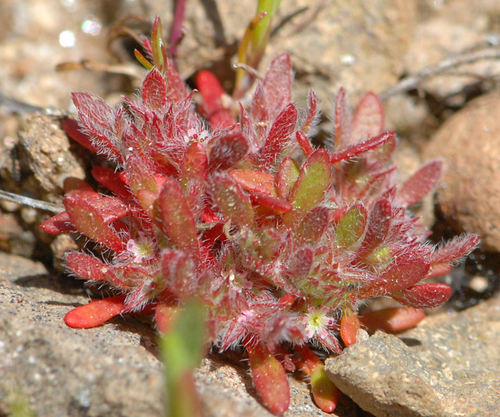
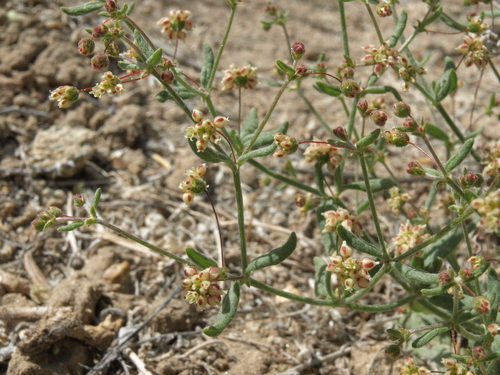
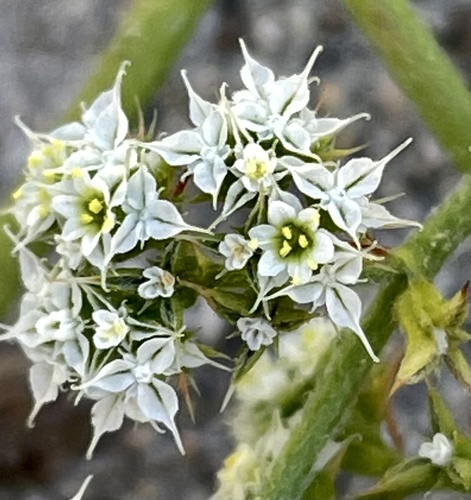
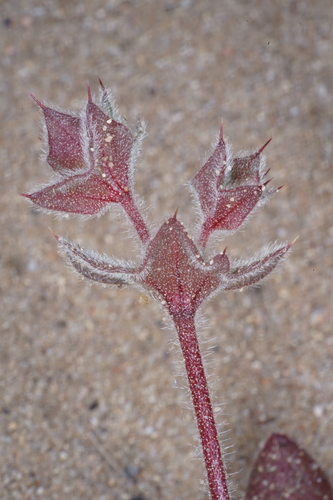
Mucronea californica Benth. is an ephemeral annual plant. It grows narrow leaves arranged in a basal rosette, and produces a spiny, awn-covered inflorescence bearing white to pink flowers at its top. This species typically reaches 5 to 30 cm in height and 10 to 60 cm in diameter. Its leaves form a basal rosette, each attached to the plant by a petiole 0.5 to 3 cm (0.20 to 1.18 in) long. The leaves are shaped narrowly spatulate to obovate, measuring 1 to 5 cm (0.39 to 1.97 in) long and 2 to 8 mm (0.079 to 0.315 in) wide. The inflorescence is cyme-like, and holds 3 bracts that range from spreading to nearly erect. The bracts are connate for half of their length, and shaped triangular to ovate or oblong. At the terminal nodes, bracts become acerose, then linear to linear-lanceolate, measuring 0.5 to 1 cm (0.20 to 0.39 in) long, with an apex that is acute to obtuse. The entire inflorescence is covered in awns that are 1 to 2.5 mm (0.039 to 0.098 in) long. Its involucres are 3-angled, obscurely ribbed, and bear 3 teeth. The surface of involucres ranges from glandular to slightly hirsute, and also carries awns 1 to 2.5 mm (0.039 to 0.098 in) long. Flowering occurs from March to August. Individual flowers have a perianth 1.5 to 2.5 mm (0.059 to 0.098 in) in size, that is pubescent near the base on its lower surface. The tepals are oblong, with an entire apex, and the plant produces 6 to 9 stamens. The fruits are achenes that measure 2 to 3 mm (0.079 to 0.118 in). This species is endemic to California. It occurs mostly along the Pacific Coast from San Luis Obispo south to San Diego County, with additional populations inland from Monterey County to western Riverside County. It grows in sandy openings across a variety of habitats, including coastal sage scrub, chaparral communities, dunes, grasslands on sandy substrates, and pine-oak woodlands. It is threatened and has experienced substantial decline from extensive urbanization in southern California, which has caused it to be locally extirpated across much of its historical range.