About Mucidula mucida (Schrad.) Pat.
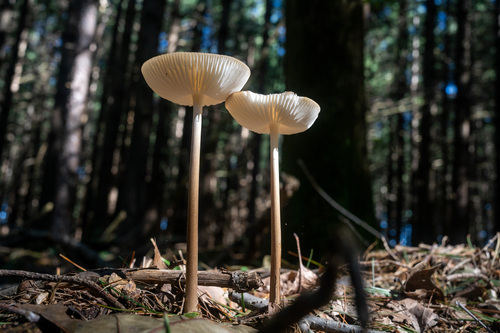
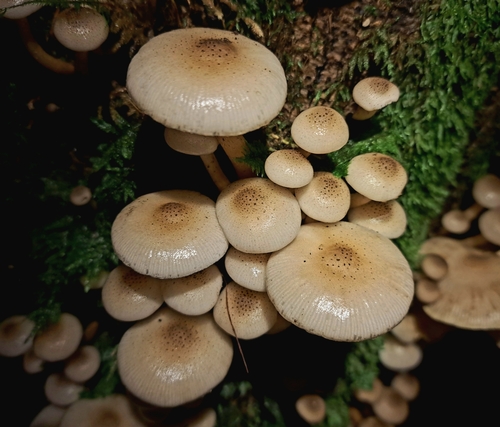
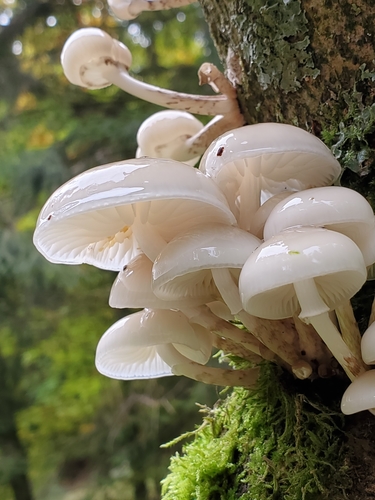
This species, formally known as Mucidula mucida (Schrad.) Pat., is commonly called the porcelain mushroom or porcelain fungus. The caps of Mucidula mucida measure 2–8 cm across. They start out strongly convex, and become mildly flattened as they age. Young caps are pale greyish; they grow whiter as they mature, become covered by a semi-translucent, slimy membrane, and often develop an ochraceous flush at the center. The cap surface layer is hymeniform: it resembles spore-bearing tissue and has erect club-shaped cells, but does not have functional basidia. The stems are slender, 30–100 mm tall and 3–10 mm wide. Above a substantial membranous ring, stems are white and striate; below the ring, they are slightly scaly and greyish. The flesh is thin and white. The lamellae are adnate, broad, and very distant. Cystidia are thin-walled, and shaped cylindric or utriform. The spore print is white. Spores are smooth, subglobose, thick-walled, and measure 13–18×12–15 μm. When Mucidula mucida grows from the underside of a tree, the stems curl such that all caps are held horizontally, with the gills facing downward. Mucidula mucida is seldom confused with other fungi. Porcelain fungus is native to Europe, and is specifically associated with beech wood. It appears in autumn, growing on dead tree trunks and fallen branches, and is occasionally found growing on dead branches high up in living trees. It acts as a saprobe or a weak parasite on living beech trees. Though it is strongly tied to beech, it has rarely been found growing on oak. Mucidula mucida occurs across northern and central Europe, wherever beech trees grow, and is a common species within its native beech habitat. When Mucidula mucida grows on a beech tree, it usually outcompetes other local fungi using a powerful anti-fungal compound called strobilurin.