About Morus nigra L.
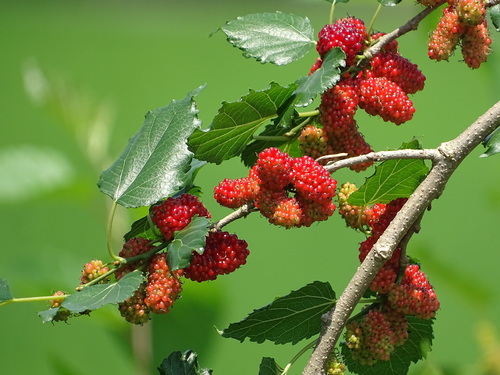
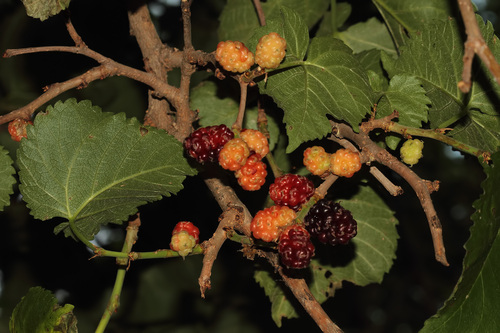
Morus nigra L., commonly known as black mulberry, is a deciduous tree that reaches 12 metres (39 feet) tall and 15 metres (49 feet) broad. Its leaves are typically 10–20 centimetres (4–8 inches) long by 6–10 centimetres (2–4 inches) broad, though they can grow up to 23 centimetres (9 inches) long on vigorous growing shoots. The underside of the leaves is downy, while the upper surface is rough due to very short, stiff hairs. It can be distinguished from other mulberry species, particularly black-fruited white mulberry individuals that are often confused with it, by the uniformly hairy lower leaf surface. Each of its somatic cells holds a total of 308 chromosomes, and it exhibits tetratetracontaploidy (44x): its base genome contains seven chromosomes, and each somatic cell holds 44 copies of each. This is reported to be the highest number of polyploidies among any known spermatophyte species. Its fruit is a compound cluster made of multiple small drupes, which turns dark purple, almost black, when ripe, and measures 2.5 centimetres (1 inch) in diameter. Its fruit has a rich flavor, more similar to that of red mulberry (Morus rubra) than the milder, less flavorful fruit of white mulberry (Morus alba). The color of mulberry fruit comes from anthocyanins. Black mulberries are thought to have originated in the mountainous areas of Mesopotamia and Persia, which corresponds to the Armenian highlands. It has been planted and often naturalized west across much of Europe, including Ukraine, and east as far as China. It is now widespread throughout Armenia, Afghanistan, Iraq, Iran, India, Pakistan, Syria, Lebanon, Jordan, Palestine, Israel, and Turkey. The fruit is edible, and the species has long been cultivated for this trait. Both the tree and its fruit are known by Persian-derived names: toot (mulberry) or shahtoot (شاه توت, meaning king's or "superior" mulberry); in Arabic, it is called shajarat tukki. In the regions where it is widespread, the fruit is often used to make jams and sherbets. The fruit has been present in the Southern Levant since antiquity. In the Books of Maccabees, it is recorded that Greeks used the fruit to provoke their war elephants before battle against Jewish rebels during the Maccabean Revolt in the 2nd century BCE. It is also mentioned in the Mishnah and later rabbinic texts. In the 9th century CE, Al-Kindi wrote that the fruit has healing seeds; in the 11th century, Ibn Badis noted the plant was used to produce ink. In Europe, the largest-documented local concentration of black mulberries grows in the vineyards of Pukanec, Slovakia, where 470 black mulberry trees grow, with around 400 additional trees growing in the surrounding villages. Black mulberry was imported to Britain in the 17th century in the hope that it would be useful for cultivating silkworms (Bombyx mori). This effort was unsuccessful, because silkworms prefer white mulberry. However, these historical plantings left a legacy of large, mature black mulberry trees in many British country house gardens. Two cultivars, M. nigra 'Chelsea' (also known as 'King James'), and M. nigra 'Jerusalem', have received the Award of Garden Merit from the Royal Horticultural Society; both cultivars are female and self-fertile. Black mulberry was widely used in folk medicine, especially to treat tapeworm. Genetic diversity research sampling over 250 old black mulberry trees from Turkey, Iran and Azerbaijan found no detectable genetic diversity among sampled individuals. This suggests that all existing black mulberry trees, both in the hypothesized area of origin and across the rest of the world, are clones. This lack of diversity may be the result of propagation by cuttings and layering, supplemented by apomictic seed formation.