About Morus indica L.
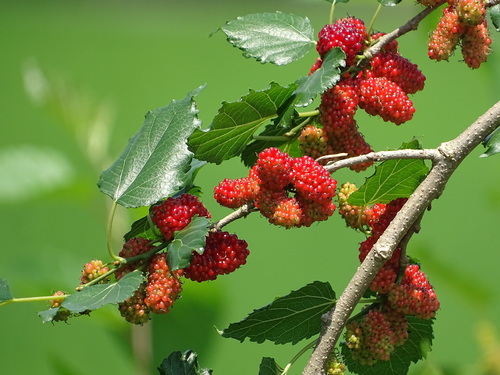
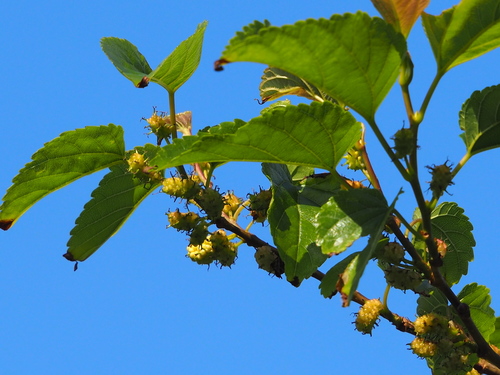
Morus indica L. is a member of the mulberry family, and like other mulberries it most often grows as a small tree or shrub, rarely reaching heights above 10 to 15 meters (33 to 49 feet). Young branches are covered with fine, soft hairs, but these hairs are lost as the branches mature. Mature branches have a light gray-brown color. Leaves are 4 to 12.5 centimeters (1+1⁄2 to 5 inches) long, 2.5 to 7.5 centimeters (1 to 3 inches) wide, and attach to the plant via petioles. Leaves are usually ovate and sometimes lobed, ending in a narrow point that is between caudate and acuminate. Leaf bases range from retuse to slightly cordate, with a small lobe at the base. Leaf edges are shortly serrated, with each tooth narrowing into a thin, apiculate point. The upper leaf surface is dark green, while the paler underside is covered in fine hairs. Morus indica is commonly cultivated for its medicinal properties. Like most berries, the mulberries produced by this species have strong antioxidant effects. Its main medicinal use is to regulate blood glucose levels for people with diabetes. Multiple studies conducted in humans and mice have found that use of Morus indica lowers the blood glucose levels of people with diabetes, working through a number of different pathways.