About Morpho polyphemus Westwood
Scientific name: Morpho polyphemus Westwood
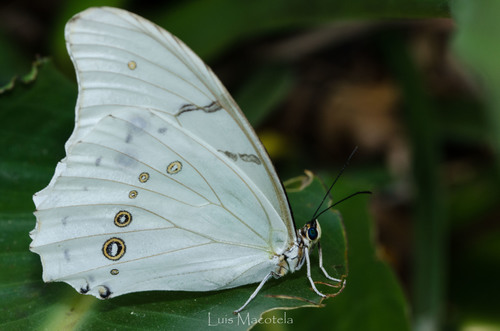
Identification: Both the upper and lower wing surfaces are bright white, with a few small light brown markings. A row of small eyespots is present on the underside of the hindwings.
Full description from Hans Fruhstorfer's account in Die Gross-Schmetterlinge der Erde: M. polyphemus Db. & Hew. (68c) differs from its Brazilian relatives in the chalky white upper surface of both wings, which has a delicate mother-of-pearl gloss. It also differs in the projecting apex of the forewing and the sharp teeth of the hindwing. Black distal bordering is absent from the upper wing surface, and the discocellular area only shows a quite narrow stripe. The forewing eyespots are larger than those of Morpho catenarius, and the eyespots of the wing have more distinctly white centers. Butler described an aberration from Mexico as Morpho luna, which has unusually well-developed black spots on both wings.
The flight of M. polyphemus is extremely rapid and irregular. According to Godman and Salvin, the species ascends to 4000 ft (1200 m) in Guatemala, and is often encountered near the ground in villages, as well as at height around the tops of trees in timber forests. It is distributed from Mexico to Guatemala and Nicaragua, and occasionally also occurs in Panama.