About Morpho amathonte Deyrolle, 1860
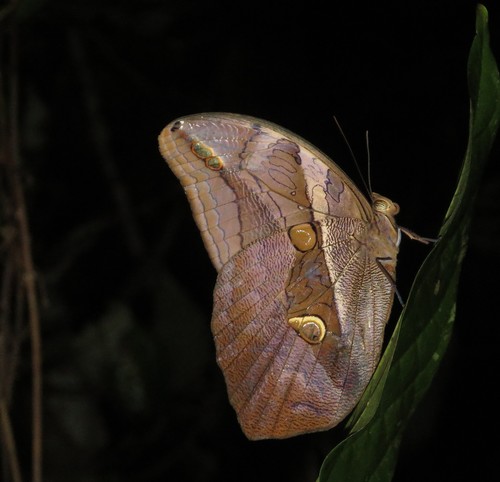
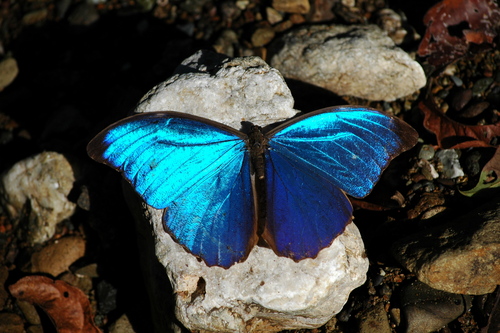
Morpho amathonte Deyrolle, 1860 has a wingspan of approximately 100 to 150 millimetres, or 3.9 to 5.9 inches. It takes this species around 120 days total to develop into an adult: 14 days as an egg, 83 days as a larva, and approximately 19 days as a pupa. Females prefer to breed on isolated trees in intact forests, even though their host plant is a common, abundant tree found in secondary woods. This species displays clear sexual dimorphism that distinguishes males from females. The base color of males is bright metallic blue, sometimes just bluish. In females, the upper wing surfaces are partially blue, have wide dark gray-brown margins, and feature small white spots that run along the outer edge of both wings. Morpho amathonte can be told apart from closely related species by a large dark spot at the tip of its forewings. The undersides of the wings are brown, lightening toward the edges, with three or four distinct, brightly colored eyespots clearly visible on each wing. Unlike the subspecies Morpho amathonte ecuadorensis from northwestern Ecuador, Morpho amathonte canyarensis from western Ecuador has lighter brown wing coloration. This shows the color difference varies between subspecies, not within a single subspecies. This species is distributed across Panama, Costa Rica, Venezuela, Colombia, and Ecuador. In Costa Rica specifically, the recorded hostplants for M. amathonte are Dichapetalum grayumii (family Dichapetalaceae), Dioclea malacocarpa, Leucopogon oliganthus, Lonchocarpus macrophylus, Machaerium seemannii (family Fabaceae), P. hayesii, Pterocarpus rohrii, Prestoea decurrens (family Arecaceae), and Pterocarpus officionalis (family Fabaceae).