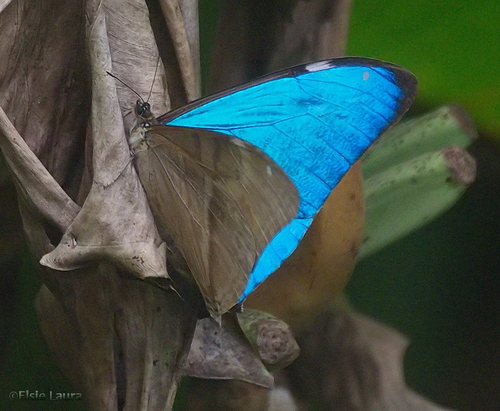
About Morpho aega (Hübner)
Morpho aega (Hübner) is one of the best-known Morphids, and one of the most common among males. Within its relatively narrow distribution range, it exhibits interesting geographical variation. The name-type aega Hbn. (66 b) likely originated from the state of Rio de Janeiro, Brazil. von Bonninghausen notes the species does not occur in the city of Rio de Janeiro itself, only in the northwest of the state that shares this name, and its distribution probably extends as far as Santa Catarina. The female was first illustrated by Staudinger; it differs from the illustration of mellinia (66 b) in having darker coloration, smaller transcellular patches on the forewing, and much larger submarginal spots on the hindwing.
mellinia Fruhst. differs from females collected from Rio de Janeiro in having a more extensive black border on both wings, and much broader black thickening of the forewing veins. It also has a broader black spot at the apex of the forewing cell, and larger yellow circumcellular patches. The lower median vein at its base, and the submedian vein in its middle, are bordered by broad patches of black scales. The hindwing is a darker red-brown, the distal border is more broadly black, and the yellowish rounded patches are considerably smaller.
bisanthe Fruhst. (66 b), with a type specimen from Santa Catarina, is the southern form of this collective species. Females can be immediately recognized by their almost uniformly large yellowish submarginal spots, which mostly extend from the anal angle to the apex, while in aega and mellinia these spots do not extend beyond the median part of the forewing. The circumcellular spots are larger and lighter. The black spot before the apex is narrower, more diffuse, and only extends to the middle of the anterior wall of the cell. The ground color of yellow females is much paler, with no brown tinge on the hindwing; the submarginal patches of the forewing are more uniform, forming a more complete row.
Females of this species are among the most variable of all Morphids, and three principal female forms can be distinguished. The first is the normal, most common, predominantly brown-yellow female, analogous to that of mellinia. This is likely the ancestral form that still resembles Brassolids, making it the oldest phyletically. The second is mixta Fruhst., which has partial blue iridescence on the forewing (66 b). The third is pseudocypris Fruhst. (66 c), where the yellow-brown ground color is replaced by dark or light blue that covers the entire upper surface.
While the males the author examined from Rio de Janeiro, Paraná, and Blumenau have no notable differences between them, males of bisanthe from Rio Grande do Sul can be immediately separated from more northern populations by their predominantly white-grey underside, instead of the purple-brown underside of northern forms. The underside of bisanthe males is also crossed by more sharply defined longitudinal bands that have stronger black borders, making them more distinct; these bands are grey-white or pale yellow. Female bisanthe are also paler yellow on the underside, and the pseudocypris form has more prominent light areas than mellinia.
In northern Espírito Santo, the climate is almost uniformly hot and damp year-round, supporting a continuous, vast forest that covers the province’s largely unknown interior. This region produces a dark-colored form, which can be described as a rainy-season form. In contrast, Rio Grande do Sul has strongly distinct seasons and large temperature extremes. Dry prairies extending from Argentina restrict the original forest to a relatively narrow tract on the eastern slopes of the coastal mountains, and this region produces a pale race with all the characteristics of a dry-region form.
Mabilde states that bisanthe appears for 10 to 15 days in spring, and 20 to 40 days in autumn, along forest paths. Burmeister recorded a Morpho aega race with blue females from Misiones, Argentina, which was discovered there by Carlos Berg. Around 10 to 15 males are found for every one of the rare females.