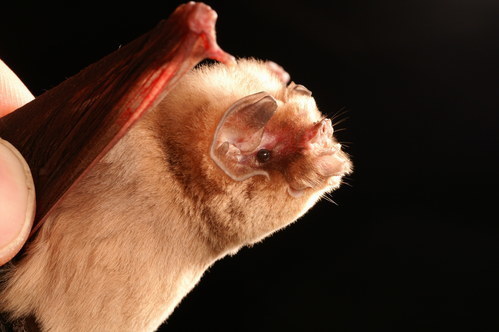
About Mormoops megalophylla (Peters, 1864)
Common Name & Size
Mormoops megalophylla, commonly known as the ghost-faced bat, is a medium-sized bat with a color range from reddish-brown to dark brown.
Fur Color Change
The reddish tint of its fur becomes more prominent as the pelage ages.
Molting Period
Ghost-faced bats molt annually, typically between June and September.
Molting Pattern
Molting starts on the shoulders and spreads across the back on the dorsal side; on the ventral side, it usually begins under the wings, on the neck and chin, then spreads downward across the abdomen.
Facial Morphology
These bats have a characteristic 'smashed-in' facial appearance, caused by four combined factors: underdeveloped noses, foreheads that rise abruptly from the nose, very thick dermis and muscle fibers in the face, and large round ears that appear to join across the forehead.
Body Temperature
Ghost-faced bats maintain an unusually high body temperature that is typically a few degrees higher than the surrounding ambient temperature.
Cold Temperature Sensitivity
This makes them sensitive to temperatures below 10 °C, and they can only survive these colder temperatures for a few hours before dying of hypothermia.
Climate Preference
Ghost-faced bats prefer warm climates.
Roosting Social Structure
They typically roost in large colonies, but do not cluster tightly; they maintain a specific spacing of approximately 15 cm (5.9 in) between individual roosting bats.
Foraging Movement
They leave their roosts, which are most often caves, mine shafts, or tunnels, at night, flying in dense, fast-moving groups until they reach their feeding grounds, where they disperse.
Diet & Feeding Habitat
Their main food source is large-bodied moths, and they often feed over areas of standing water.
Colony Health Risks
Because they roost in large colonies, ghost-faced bats are susceptible to parasites and rabies, which are known to eliminate entire colonies.


