About Mormolyce phyllodes Hagenbach, 1825
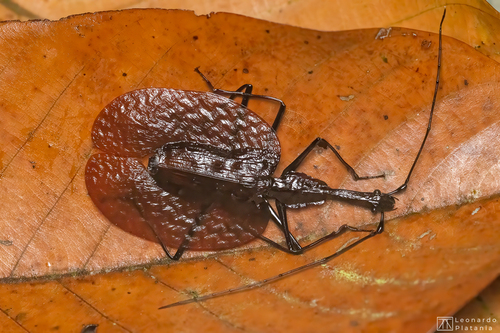
Mormolyce phyllodes (Hagenbach, 1825) grows to a length of 60–100 millimetres (2.4–3.9 inches). These beetles have a flat, leaf-shaped, shiny black or brown body with distinctive violin-shaped translucent elytra, which gives the species its common name. This characteristic mimicry protects the beetles from predators, and their flat body shape lets them live in soil cracks, or under the bark and leaves of trees. Their head and pronotum are very elongated, with long antennae, and their legs are long and slender. The habits of beetles in the Mormolyce genus are still not well understood. From the few studies completed to date, researchers have found that the larval habits of Mormolyce phyllodes are completely different from most other ground beetles (Carabidae). The larvae of this species live inside large, very hard bracket fungi—these fungi are 20 to 30 cm wide or even larger. The larvae excavate channels within the fungi and also pupate inside the fungal tissue. After emerging from the pupal stage, adults create an extremely small exit hole that is narrower than their own bodies to leave their larval chambers. It remains unclear how they are able to escape through this small opening, even when accounting for the softness of their tissues after emergence. Like other Carabidae, adult Mormolyce phyllodes are predatory. For defense, they secrete poisonous butyric acid. The larvae develop within the tissue of bracket fungi from the genus Polyporus. Their full developmental cycle lasts 8–9 months, and the pupal stage alone lasts 8–10 weeks. Adult beetles are active in flight from August to November. This species occurs in the rainforests of Southeast Asia, found in Brunei, Indonesia, Java, Malaysia, and Sumatra.