About Moringa peregrina (Forssk.) Fiori
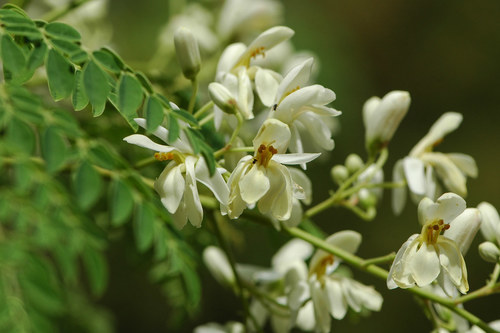
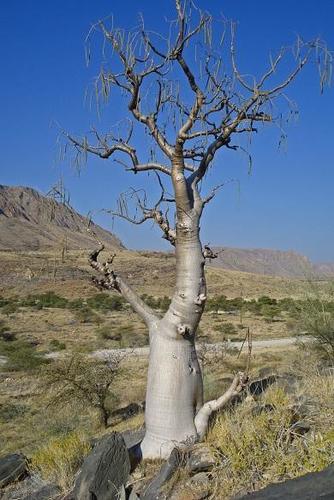
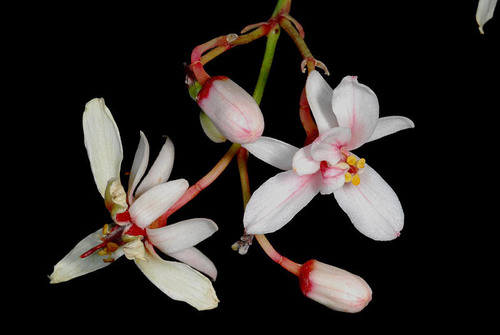
Moringa peregrina (Forssk.) Fiori is a small deciduous tree that reaches 6 to 10 meters in height. It has large leaves and thin, hanging branches, and it blooms twice per year, once in spring and once in autumn. Its flowers have five petals, and are white or marked with red or pink streaks. Its fruits are distinct, can be seen hanging from the tree's branches year-round, are narrowly cylindrical, grow up to 30 cm long, and have deep longitudinal grooves. When ripe, the fruit splits into three valves to release large, whitish seeds, which are known as behen-nuts.
This species is distributed across northeastern Africa and southwestern Asia. In Africa, it grows in Egypt, Sudan, Libya, and all Horn of Africa countries: Eritrea, Ethiopia, Djibouti, and Somalia. It also grows across the Arabian Peninsula, as well as in Israel, Jordan, Palestine, and Syria. Its estimated total extent of occurrence is over 5,791,000 km². It grows on rocky slopes of wadis and gullies, and in Acacia–Commiphora woodland. In Israel, it is protected by law, growing on rugged desert rock faces and canyons along the Dead Sea, particularly near watercourses such as Ein Gedi, Naḥal Gob (near the lower Naḥal Sīn), and near the al-Ḥama springs at the entrance to Wadi Qelt.
Moringa peregrina has a long history of traditional use. It has been used locally for home construction and fuel for fires, while its leaves are eaten as food and used as livestock feed. In eastern Oman, young saplings are dug up and their roots are slowly roasted over fire to be eaten. In Oman, oil extracted from the tree's pods is used in traditional medicine and perfumery. The seeds contain a fragrant, light oil that has the unusual, valuable property of not going rancid. In the Middle Ages, this oil was used as a base for certain perfumes. Bedouins in Egypt supplied behen-nut seeds to the Cairo market; the fine oil extracted from these seeds was used as a lubricant for mechanical watches. For their own cooking use, Bedouins followed superstitious practices when extracting oil from behen-nuts. After collecting seeds from the pods, they boiled the seeds in water, then skimmed off the oil that rose to the surface. The fire used for this process could only be made from Moringa peregrina (yasaar) wood. The person extracting the oil always did so alone, as they believed being watched would result in a much lower yield, or no yield at all. High quality behen oil is produced from seeds of Moringa peregrina growing in Hijaz, Saudi Arabia, and in Yemen. The best quality seeds have a blackish peel; white seeds cause frothing to form on the surface of the liquid when cooked. Traditionally, Bedouins have used solidified resin extracted from the seeds to rosin the strings of the rebābah, an Arab violin.