About Moringa oleifera Lam.
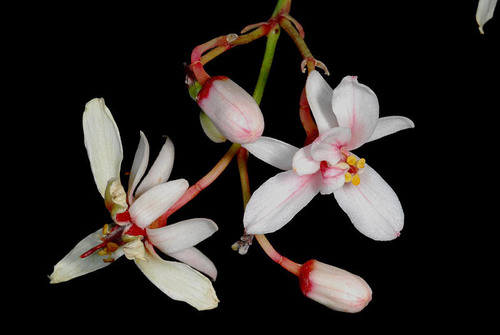
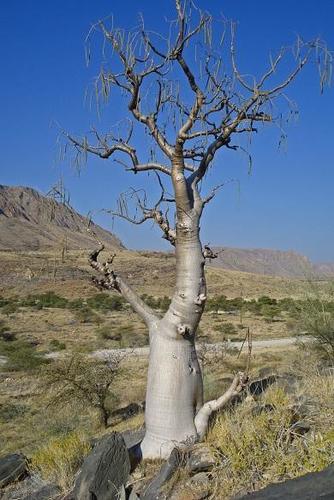
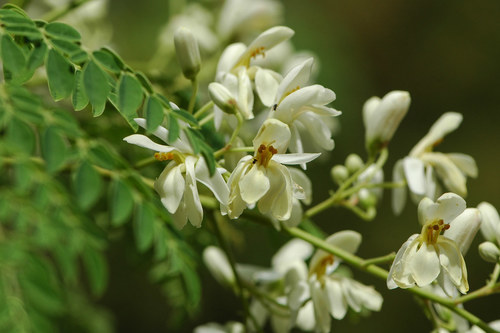
Moringa oleifera Lam. is a fast-growing deciduous tree that reaches 10–12 m (33–39 ft) in height, with a trunk up to 46 cm (18 in) in diameter. Its mature bark is whitish-gray with a thick outer cork layer, while young shoots have purplish or greenish-white hairy bark. The tree forms an open crown of drooping, fragile branches, and bears feathery foliage made up of tripinnate leaves. Its fragrant hermaphroditic flowers have five unequal, thinly veined yellowish-white petals; each flower is roughly 1–1.5 cm (3⁄8–5⁄8 in) long and 2 cm (3⁄4 in) wide, growing on slender hairy stalks in spreading or drooping flower clusters 10–25 cm (4–10 in) long. Flowering begins within the first six months after planting. In regions with cool seasonal changes, flowering only occurs once annually in late spring and early summer (April to June in the Northern Hemisphere, October to December in the Southern Hemisphere). In areas with consistent temperatures and year-round rainfall, flowering can happen twice a year or continuously. Its fruit is a hanging, three-sided brown capsule 20–45 cm (8–17+1⁄2 in) long, which holds dark brown, globular seeds around 1 cm in diameter. The seeds have three whitish papery wings and are dispersed by wind and water. In cultivation, the tree is often cut back annually to 1–2 m (3.3–6.6 ft) and allowed to regrow, to keep pods and leaves within easy reach for harvest. In both its native and introduced ranges, Moringa oleifera is not affected by any serious diseases. In India, it plays host to several insect pests, including multiple types of caterpillars: bark-eating caterpillars, hairy caterpillars, and green leaf caterpillars. Budworms from the Noctuidae family are known to cause severe defoliation, and other damaging pests include aphids, stem borers, and fruit flies. In some regions, termites can cause minor damage, and if termite populations are high in the soil, managing them becomes cost-prohibitive. It also acts as a host for Leveillula taurica, the pathogen that causes powdery mildew, which damages papaya crops in southern India. Additionally, caterpillars of the snout moth Noorda blitealis feed primarily on M. oleifera leaves and can cause complete defoliation. Data on toxicity of M. oleifera in humans is limited, but laboratory studies show that certain compounds in the bark, roots, and their extracts may cause adverse effects when consumed in excess. Supplementation with M. oleifera leaf extract is potentially toxic at doses exceeding 3,000 mg per kg of body weight, but is safe at doses below 1,000 mg per kg. A study in albino mice found that high consumption levels (over 5,000 mg/kg) can impair renal function. M. oleifera may also interact with prescription drugs that affect the cytochrome P450 enzyme system, including CYP3A4, and may inhibit the antihyperglycemic effect of the drug sitagliptin. Moringa oleifera is primarily cultivated in semiarid, tropical, and subtropical areas, which correspond to USDA hardiness zones 9 and 10 in the United States. It tolerates a wide range of soil conditions, but grows best in neutral to slightly acidic (pH 6.3 to 7.0), well-drained, sandy or loamy soil. Roots tend to rot in waterlogged soil. As a sun- and heat-loving plant, it does not tolerate freezing temperatures or frost. It is particularly well-suited for dry regions, as it can be grown using only rainwater, without expensive irrigation infrastructure. Throughout the regions where it grows, M. oleifera has many uses in cooking. Edible parts of the plant include whole leaves (leaflets, stalks, and stems), immature green fruits or seed pods, fragrant flowers, young seeds, and roots. The bark, sap, roots, leaves, seeds, and flowers are used in traditional medicine. Research has investigated how M. oleifera may affect blood lipid profiles and insulin secretion. Leaf extracts contain various polyphenols, which are undergoing basic research to assess potential effects in humans. Despite extensive preliminary research to identify bioactive properties of moringa components, there is no high-quality evidence to confirm that it has any effect on human health or disease. In developing countries, moringa has potential to improve nutrition, increase food security, support rural development, and contribute to sustainable land management. It can be used as livestock forage, a source of micronutrient liquid, a natural anthelmintic, and a possible adjuvant. Moringa tree cultivation has been used to address malnutrition, especially among infants and nursing mothers. Because it thrives in arid and semiarid environments, it can provide a versatile, nutritious food source year-round in many geographic regions. Around 140 organizations worldwide have started moringa cultivation programs to reduce malnutrition, purify water, and produce cooking oil. When pre-wetted, Moringa oleifera leaf powder is just as effective as soap for hand washing, due to the antiseptic and detergent properties of its leaf phytochemicals. Moringa oleifera seeds and press cake have been used as wastewater conditioners for dewatering and drying fecal sludge. Moringa seed cake, a byproduct from pressing seeds to extract oil, is used to filter water through flocculation to produce potable water for humans or livestock. Moringa seeds contain dimeric cationic proteins that absorb and neutralize colloidal charges in turbid water, causing colloidal particles to clump together. This clumping makes suspended particles easier to remove as sludge via either settling or filtration, and seed cake removes most impurities from water. This application is of particular interest because it is nontoxic and sustainable compared to other materials in regions that grow moringa where drinking water is contaminated by pollutants.