About Moraea aristata (D.Delaroche) Asch. & Graebn.
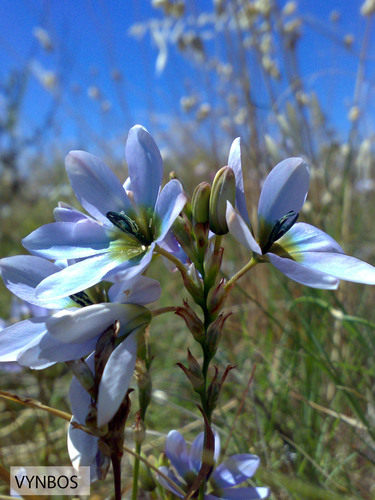
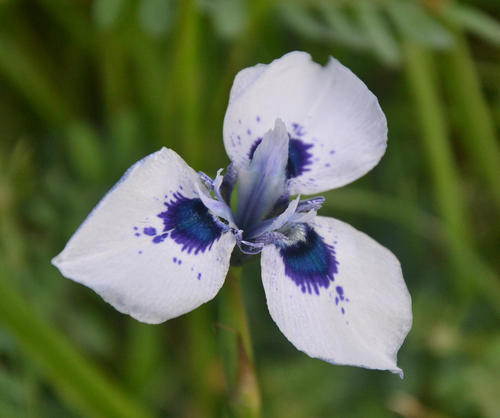
Moraea aristata (D.Delaroche) Asch. & Graebn. is a winter-flowering bulb geophyte that produces large, striking flowers. It grows 25–35 cm (9.8–13.8 in) tall and sometimes branches once, with a single linear leaf growing from its base. This leaf is usually longer than the stem, and often trails along the ground. Both the stem and leaf are hairless. The species' corms have a diameter of around 15 mm (0.59 in) and are covered in pale fibers. Flowers bloom in September, growing at the end of the stem, or sometimes on short side branches. Each outer petal is white, with a large iridescent blue spot at the base. These blue patches are outlined in violet, or sometimes yellow, and have a broad, black, hairy base. The tepal claws are yellow, speckled with black or violet. The inner petals split into three lobes, with a long, straight central cusp. While each individual flower lasts only three days, several flowers are produced over a period of three to four weeks. Its seed capsules are oblong in shape and split open from the top, holding light brown, angular seeds. This plant naturally occurs only in Peninsula Shale Renosterveld vegetation in northern Cape Town. Due to urban growth, most of its original habitat is now covered by urban sprawl. Until recently, the only surviving natural population was found in the grounds of the South African Astronomical Observatory in the suburb of Observatory, near the foot of Devil's Peak. This tiny, isolated population is not sustainable long-term due to low genetic diversity and ongoing human disturbance. In 2017 and 2018, the species was reintroduced to Rondebosch Common, giving new hope for its continued survival in the wild. The species has also become naturalized in Australia. This species, commonly called the blue-eyed uintjie, is pollinated by monkey beetles, which are drawn to the center of the flowers by the blue nectar guides on the petals. Its seeds are dispersed by wind, and seeds are released when the seed capsules split open during summer.