About Monticola solitarius (Linnaeus, 1758)
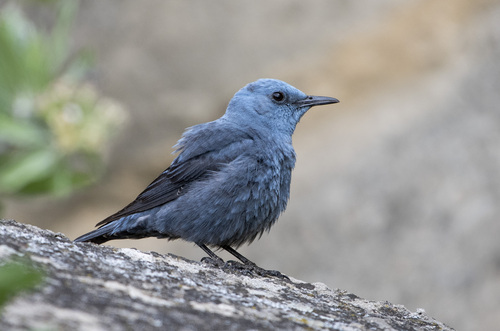
The blue rock thrush, Monticola solitarius (Linnaeus, 1758), is a starling-sized bird measuring 21–23 cm (8.3–9.1 in) in length, with a long, slim bill. The breeding male of the nominate subspecies is easily identifiable, with uniform blue-grey plumage except for darker wings. Females and immature blue rock thrushes are far less distinctive, with dark brown upperparts and paler brown, scaly-patterned underparts. Males of the subspecies M. s. philippensis have rufous-chestnut plumage from the mid-breast down to the undertail. Unlike the related rock thrush, both sexes of the blue rock thrush do not have reddish outer tail feathers. Most blue rock thrush populations in Europe, North Africa, and Southeast Asia are primarily resident, only making altitudinal movements. Other Asian populations are more migratory, and spend the winter in sub-Saharan Africa, India, and Southeast Asia. The species is a very uncommon visitor to northern and western Europe. Its breeding and wintering ranges overlap partially with that of the common rock thrush (Monticola saxatilis); the common rock thrush breeds in the Palearctic and southwestern Asia, and winters in northern Africa. The blue rock thrush has been recorded in North America on two occasions: once in British Columbia in 1997, and once in Oregon and the Farallon Islands in 2024. It is unclear whether the Oregon and Farallon Islands sightings involved the same individual. It is highly unlikely that the 1997 British Columbia sighting was the same individual as the 2024 Oregon/Farallon Islands sighting, since wild blue rock thrushes typically live 5 to 10 years. Choi et al. conducted a study of a blue rock thrush population on Hongdo Island, South Korea, between 2005 and 2009. The species arrives on the island in spring and departs in autumn, confirming that the Hongdo population is migratory rather than resident. The study estimated a breeding density of around 8 breeding pairs per square kilometer, and the average individual territory size was 2.87 hectares. Blue rock thrushes in this population showed a strong preference for rocky cliffs as habitat, particularly exposed rock faces. The study concluded that habitat structure is a more important factor for the species than food availability. Rouibi et al. conducted a study of M. solitarius in El Bouni, Algeria, over three breeding seasons from 2016 to 2018, documenting the first confirmed case of successful urban nesting by the species. The team found a blue rock thrush nest built under the roof of a residential building, a site very different from the species' usual nesting habitat of rocky cliffs, escarpments, and coastal outcrops. Blue rock thrush pairs have also been recorded living in urban areas in Malta.