About Monticola rupestris (Vieillot, 1818)
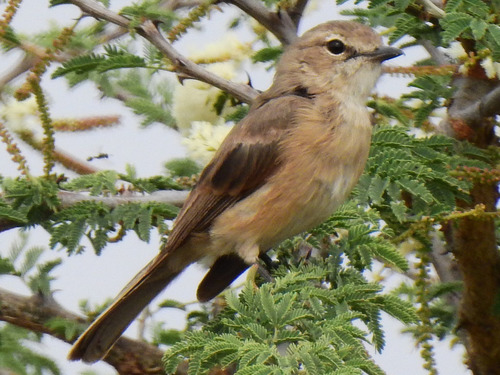
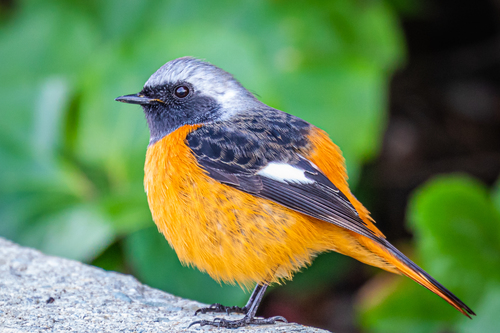
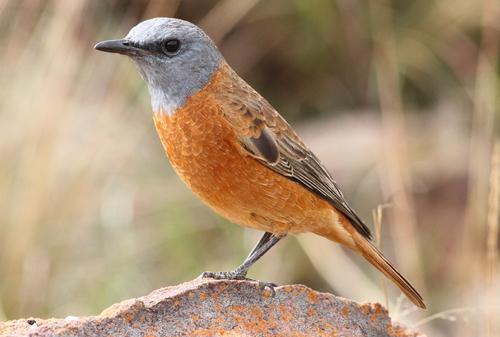
Monticola rupestris, commonly known as the Cape Rock-Thrush, is a large, stocky rock thrush that measures 21–22 cm (8.26 inches) in length. Breeding adult males in summer have a blue-grey head, orange underparts and outer tail feathers, and brown wings and back. Females have brown heads, with richer orange underparts than females of other rock thrush species. Vocal behavior is a prominent trait of this species. Males produce a whistled song transcribed as “tsee-tsee-tseet-chee-chweeeoo”, and are known to mimic other bird species. Another commonly heard call is a sequence transcribed as “wiit liio-o pii’p sii piiu chiwii trrr”, which is made up of rhythmically repeated high-pitched whistles and trills given during territorial displays. This species has a recorded life expectancy of 3.5 years. The Cape Rock-Thrush lives in mountainous rocky landscapes with scattered vegetation, a habitat similar to that used by the Sentinel rock thrush and common rock thrush. It is most often found on rocky mountain slopes between 1,200 and 3,000 meters in elevation. Its known range includes the Drakensberg Mountains, Eastern Cape, KwaZulu-Natal, Mpumalanga, and Limpopo provinces of South Africa, plus highland regions of Lesotho and Eswatini. As a member of southern Africa’s montane ecosystems, the Cape Rock-Thrush tends to sing from elevated perches during territorial displays, making it easy to spot and frequently observed by birdwatchers and researchers. It is solitary or occurs in pairs during the breeding season; juveniles stay close to their parents’ territory for a short time after fledging. The species is mostly sedentary, but moves to lower elevations in winter, abandoning the high mountain zones of Lesotho and the Drakensberg.