About Montia chamissoi (Ledeb. ex Spreng.) Greene
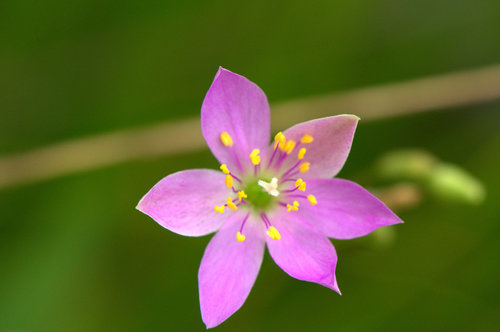
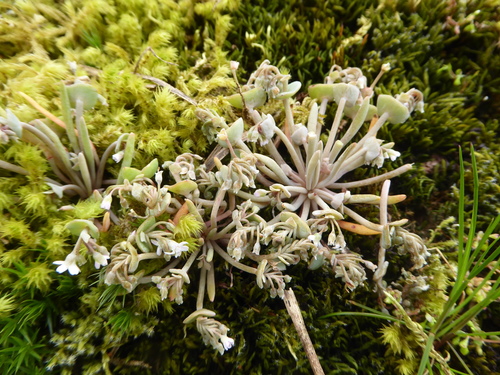
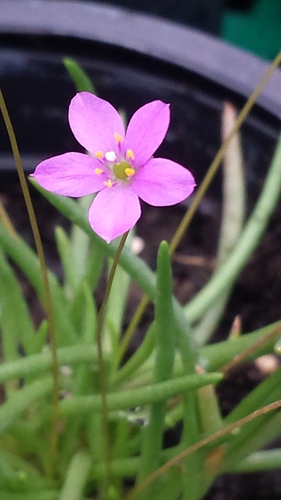
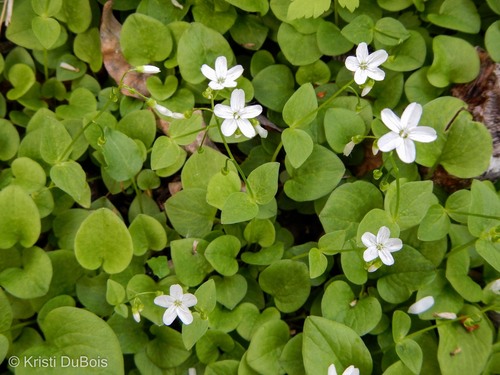
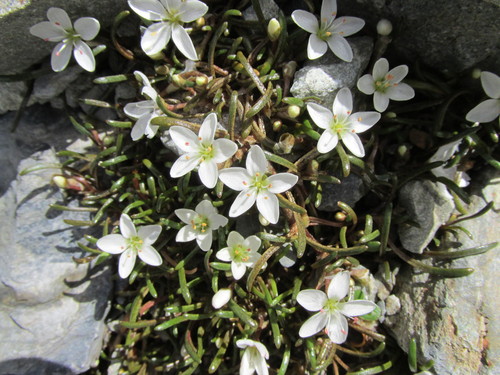
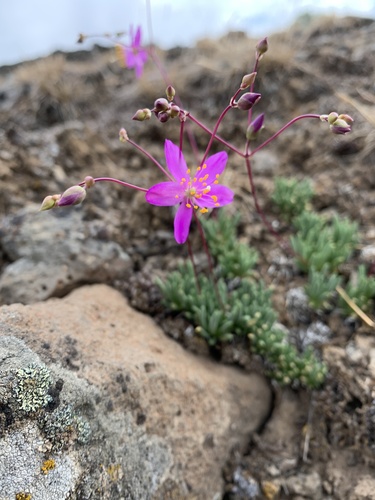
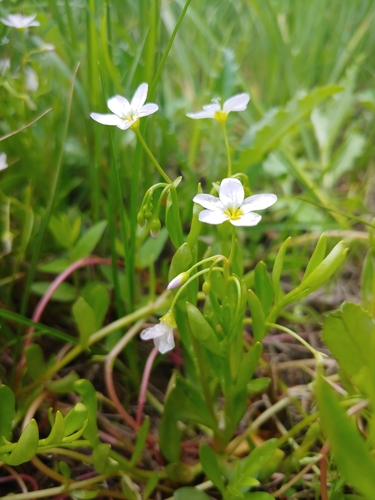
Montia chamissoi is a small perennial herb that grows from a pinkish rhizome and spreads via stolons. Its fleshy stems can be erect, creeping, tangled into mats, or floating, and reach 5 to 20 centimeters long. Its succulent pale green leaves are oblong or broadly lance-shaped, oppositely arranged, and measure 2 to 5 centimeters in length. The inflorescence is a raceme holding two or more flowers, each with two sepals; inflorescences sometimes emerge from leaf axils. Flowers usually have five white or pinkish petals that are just under one centimeter long, plus five stamens and a style tipped with three stigmas. Fruits are egg-shaped capsules widest above the middle, 2 to 3 millimeters long. The seeds inside these capsules are black, bumpy, shiny, and oblong. Flowering occurs from June to August, according to Kershaw et al., 1998. Small bulblets may grow at the ends of the plant's stolons. This species is endemic to western North America and has a wide distribution. It grows at elevations between 7,000 and 9,000 feet, and can be found in wetlands, montane areas, prairie zones, and also on dry slopes of plains and foothills. It occurs in the Rocky Mountain region, Pacific Alaska region, Pacific region, and parts of the mid-Atlantic and Great Lakes region. It is common in the Canadian provinces of Alberta and British Columbia. It is rarely found in coastal areas. In Minnesota, there is only one population covering approximately 25 square meters, located around a cold water spring, so the species is listed as endangered in this state.