About Monotropa uniflora L.
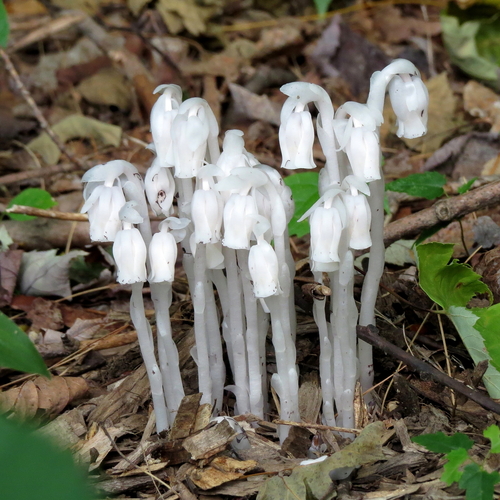
Monotropa uniflora L. has stems that grow between 5 and 30 centimetres (2 to 12 inches) tall, and are sheathed in highly reduced leaves 5 to 10 millimetres (3⁄16 to 3⁄8 inches) long. These reduced leaves are most easily identified as scales or bracts; they are small, thin, and translucent, lack petioles, and extend out from the stem in a sheath-like manner. As its scientific name suggests, each stem bears a single flower 10 to 20 mm (3⁄8 to 13⁄16 inches) long, unlike the closely related Monotropa hypopitys, and similar to Monotropastrum humile. Each flower has 3 to 8 translucent petals, 10 to 12 stamens, and one single pistil. Flowering occurs from early summer to early autumn, often starting a few days after rainfall. When seeds mature, the oval capsule-shaped fruit enlarges and becomes upright. After seed maturity, the stem and capsule become desiccated, turning dark brown or black with a brittle texture. The seeds of Monotropa uniflora are very small, with lengths ranging between 0.6 and 0.8 mm (3⁄128 to 1⁄32 inches). After pollination, seeds are pushed through a tiny slit between the petals and dispersed by wind. Unlike most plants, Monotropa uniflora is white and does not produce chlorophyll. Instead of making food using energy from sunlight, it is parasitic, and classified specifically as a mycoheterotroph. Its fungal host species all belong to the Russulaceae family. Most of these fungi are mycorrhizal, meaning they grow in symbiotic association with tree roots. Through the mycorrhizal fungal web, Monotropa uniflora roots obtain nutrients from the photosynthetic trees that its host fungi are connected to. This plant has clustered node roots covered in hair-like structures called cystidia. Cystidia on the roots allow easy attachment to fungal hyphae, a characteristic seen in ectomycorrhiza. Because Monotropa uniflora does not rely on sunlight to grow, it can grow in very dark environments such as the understory of dense closed-canopy forests. The complex symbiotic relationship required for its growth makes propagation of this species very difficult. In terms of ecology, the flowers of Monotropa uniflora are visited by multiple species of bees and flies, with bumblebees being the most common visitor. Bumblebees are an important pollen dispersal agent for the plant, crawling into the flower to collect pollen. Like most mycoheterotrophic plants, Monotropa uniflora forms associations with only a narrow range of fungal hosts, all of which are members of the Russulaceae family. It is very commonly found growing in association with beech trees. Monotropa uniflora contains glycosides and may be toxic to humans. A variety of traditional medicine uses for the plant have been reported, and it has been used as an analgesic and anxiolytic in herbal medicine since the late 19th century. This use may be explained by the presence of salicylic acid and grayanotoxins in the plant. Walter H. Prest recorded that cooked Monotropa uniflora has a flavor similar to asparagus.