About Monotoca scoparia (Sm.) R.Br.
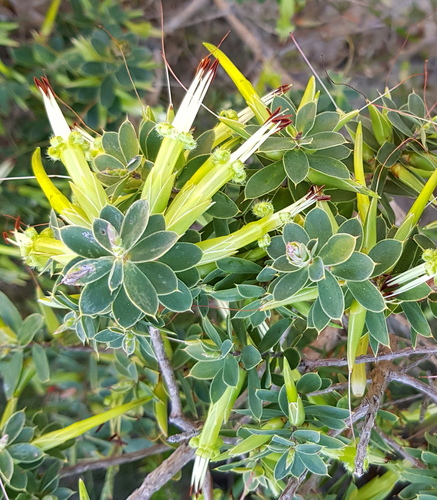
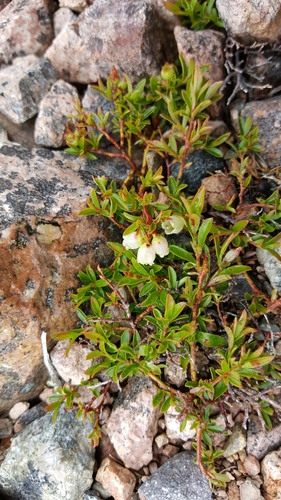
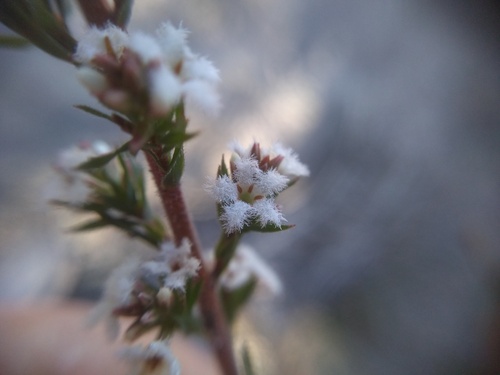
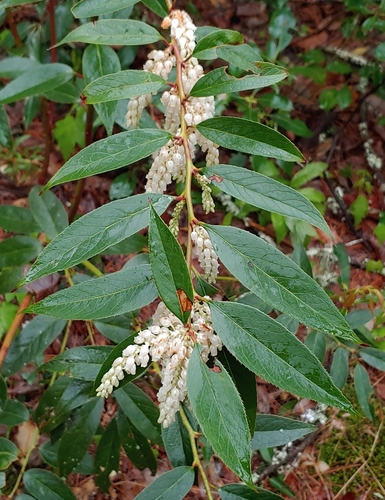
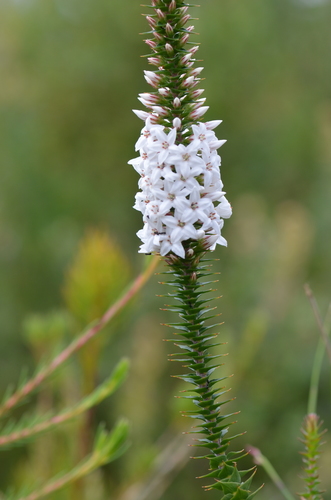
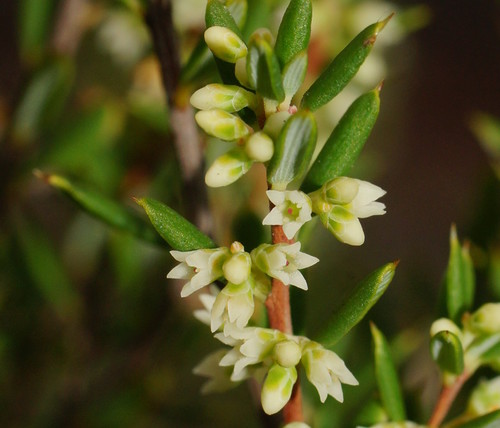
Monotoca scoparia (Sm.) R.Br. is a lignotuberous shrub that typically grows 30 to 120 cm tall. Its leaves grow in an alternating arrangement, are erect, prickly, and range in shape from narrowly oblong to elliptic. Individual leaves measure 0.6 to 2.2 cm long and 1 to 4 mm wide. The upper (adaxial) leaf surface is dark green, while the lower (abaxial) surface is pale green to whitish and marked with 3 to 5 prominent veins. Leaf tips are sharp, and young branchlets range from rough to hairless. This species is dioecious, meaning male and female flowers grow on separate plants. The flowers are tubular, white to cream in colour. They form axillary spikes of 2 to 9 clustered flowers, though the lowest flower may grow singly. The corolla of female flowers measures 1.3 to 2.8 mm long, and male corollas are slightly longer at 2 to 4 mm. A key distinguishing feature of this species is that its corolla tube is longer than its sepals. Flowering occurs through most of the year, from December to August. The fruit is fleshy, oblong, and yellow to orange. This species is widespread across Australia, with recorded observations in Tasmania, Victoria, New South Wales, Queensland, and a small number of records in the Northern Territory and South Australia. It is a common understorey shrub in dry sclerophyll forest, woodland, and heathland. It grows on well-drained sandy and rocky soils, from sea level to montane elevations, in conditions ranging from full sun to semi-shade. Tasmania is home to six native Monotoca species. All of these species are very similar and can be hard to tell apart. The species that most closely resembles Monotoca scoparia is Monotoca submutica, a Tasmanian endemic that is sometimes classified as Monotoca scoparia var. submutica. The two species are very similar in appearance, but differ in flower length, flowering time, and habitat. Monotoca submutica is widespread across southern and western Tasmania, where it grows in subalpine forest and wet sclerophyll rainforest. Monotoca scoparia is commonly cultivated in gardens. It grows best when planted in well-drained positions with full sun to semi-shade, and can become established under existing trees. It is often used in gardens for hedging and traffic control.