About Monotoca elliptica (Sm.) R.Br.
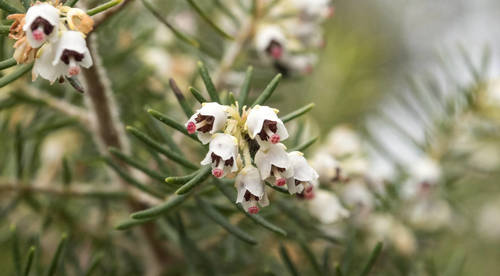
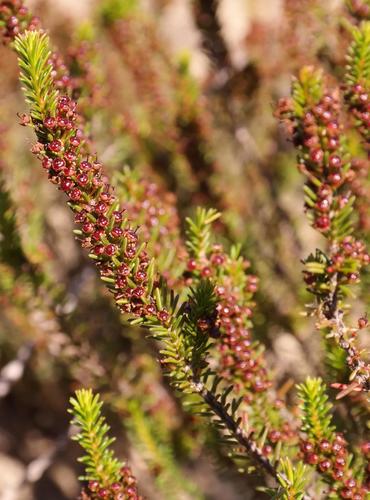
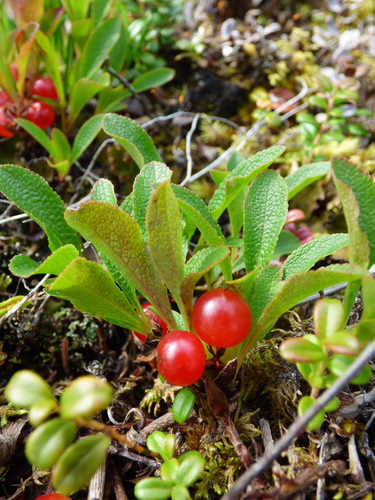
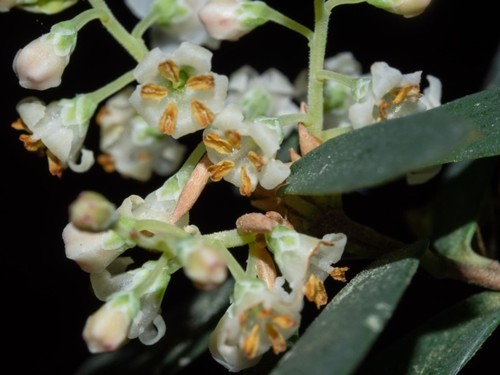
Monotoca elliptica (Sm.) R.Br. is a long-lived species that can grow for more than one hundred years. It most commonly grows as a shrub reaching around three metres tall, but exceptionally large specimens can grow up to ten metres tall. Its natural habitat is scrubland, most often in coastal areas on headlands and sand dunes. This is a widespread plant that also grows inland on ranges in regions with mid to high rainfall. Its leaves are typically 10 to 25 mm long and 3 to 7 mm wide. The underside of the leaf is paler than the upper surface, and marked with longitudinal veins. The tip of each leaf ends in a sharp prickle. Leaf shape can be elliptic, oblong, or reverse lanceolate. The leaf petiole is 1 to 2 mm long and rough to the touch. White flowers with swollen red anthers develop in late winter and early spring, arranged in racemes. Round red or orange fruits, 3 to 4 mm in diameter, form in spring and summer. Indigenous Australians traditionally ate these fruits. In early colonial times, the plant’s wood was used to make tool handles. The bark of Monotoca elliptica is dark, furrowed, and rough. Regeneration and cultivation of this species from seed is slow and difficult, though some seeds may germinate after 18 months. Growing from cuttings is generally a more successful method. This plant can be used for hedges. It is a tough, adaptable species that responds well to pruning.