About Monomorium pharaonis (Linnaeus, 1758)
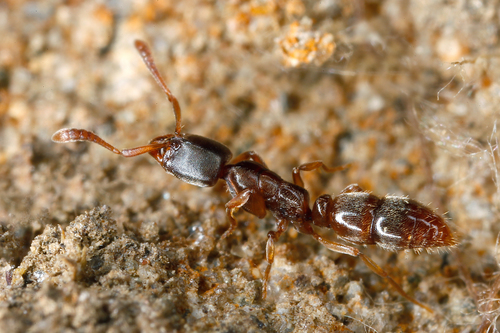
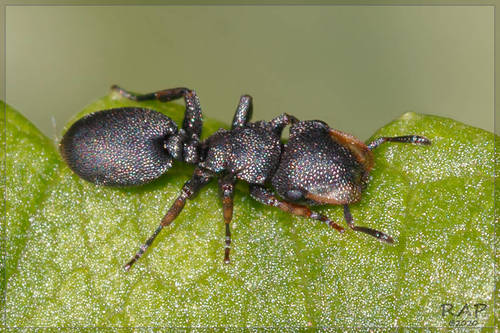
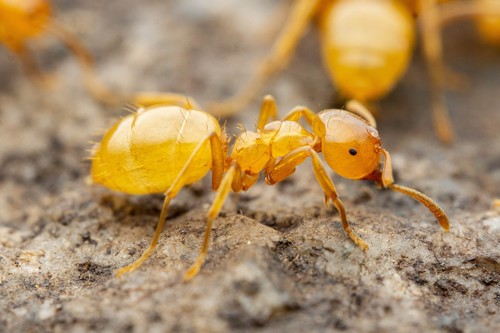
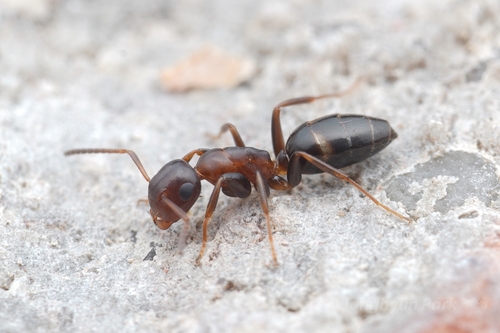
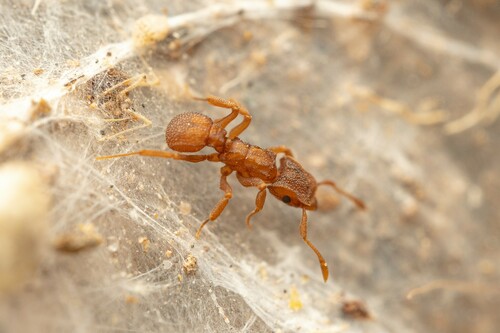
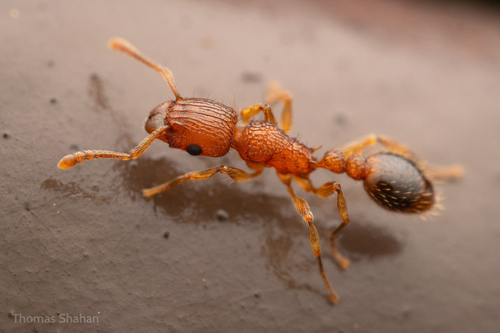
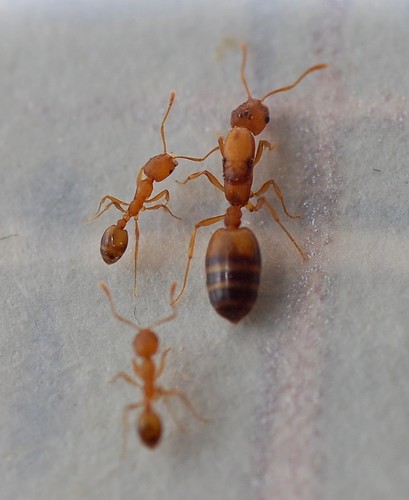
Physical characteristics: Worker pharaoh ants (Monomorium pharaonis) are around 1.5–2.0 millimetres (1⁄16 in) long. Their bodies range from light yellow to reddish brown, with a darker abdomen. Worker pharaoh ants have a non-functional stinger that they use to produce pheromones. The petiole, the narrow waist between the thorax and abdomen, has two nodes, and the thorax has no spines. Pharaoh ants have poor eyesight, with workers possessing an average of 32 ommatidia. The segments of their antennae end in a distinct club made of three progressively longer segments. Male pharaoh ants are about 3 millimetres (1⁄8 in) long, they are black and have wings, but do not fly. Queen pharaoh ants are dark red and measure 3.6–5.0 millimetres (1⁄8–3⁄16 in) long. They start out with wings that they lose soon after mating, and they also do not fly. Life cycle: A pharaoh ant queen can lay hundreds of eggs over her lifetime. Most queens lay 10 to 12 eggs per batch in the early stages of egg production, and only four to seven eggs per batch later on. At 27 °C (80 °F) and 80 percent relative humidity, eggs hatch between five and seven days after being laid. The larval period lasts 18 to 19 days, the pre-pupal period lasts three days, and the pupal period lasts nine days. It takes about four additional days for sexual female and male forms to fully develop. From egg to sexual maturity, pharaoh ants take roughly 38 to 45 days to develop, with timing depending on temperature and relative humidity. They breed year-round continuously in heated buildings, and mating takes place inside the nest. Mature pharaoh ant colonies contain multiple queens, winged males, workers, eggs, larvae, pre-pupae and pupae. Reproduction: Pharaoh ant mating happens inside the nest, and the males involved are usually not from the host colony, a pattern that ensures genetic diversity. A queen typically produces 10 to 12 eggs per batch at once, but can lay up to 400 eggs each time she mates. It can take up to 42 days for eggs to develop into mature adult ants. Each queen in a nest lives between 4 and 12 months. During copulation, sperm is transferred from the male to the female inside a structure called a spermatophore. There are several existing theories for the adaptive value of using a spermatophore. It may hold chemicals that reduce the female’s sex drive. Alternatively, it may physically block the female’s gonophore. In both explanations, the spermatophore stops the female from reproducing with other males. In short, using a spermatophore is evolutionarily favorable because it increases the chance the male’s genetic code will be passed to future generations by lowering potential competition from other males. Like copulation in many social insects, pharaoh ant copulation is harmful to the female. The male’s penis valve has sharp teeth that latch onto a thick, soft cuticular layer inside the female. This copulation method also has an evolutionary purpose. The teeth ensure sex lasts long enough to transfer sufficient sperm. Additionally, the pain the method causes the female may reduce her desire to mate again in some cases.