About Monomorium destructor (Jerdon, 1851)
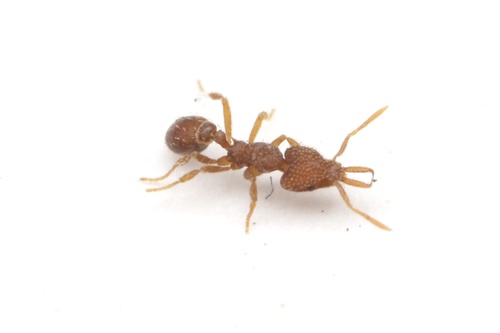
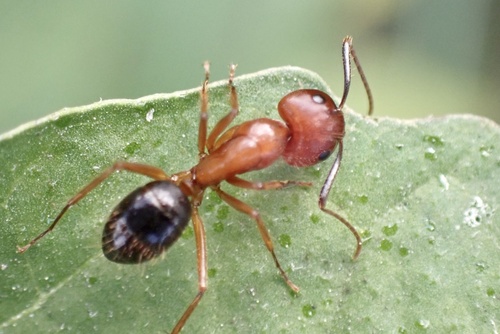
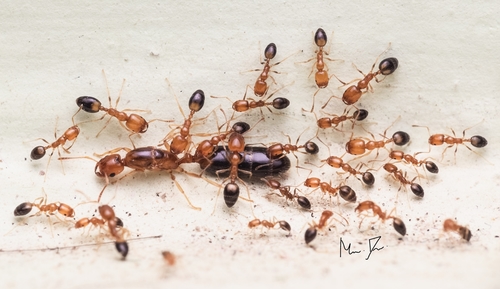
Worker Monomorium destructor ants vary in length from 1.8 to 3.5 millimeters (0.07 to 0.14 inches) and in color from light yellow to darker brownish yellow, and usually have a "chocolate" colored abdomen. Workers have square heads and 12-segmented antennae with club-shaped tips. Each worker mandible has three large teeth plus a much smaller fourth tooth. Most of the worker body is smooth and shiny, and covered with erect setae. Queen Monomorium destructor ants are between 3 and 4 millimeters (0.12 to 0.16 inches) long, tawny colored, with a brown abdomen. The queen's head is more rectangular than the worker's. Setae on the front of the queen's body are more curved, and setae on the queen's abdomen are flatter rather than erect. This species is similar to three other ant species: it differs from Trichomyrmex robustior and Trichomyrmex mayri because those species are darker in color, and it differs from M. latinode because M. latinode has five teeth per mandible instead of four. Monomorium destructor is a tramp ant and an invasive species. It easily becomes established and dominant in new habitats, thanks to traits including aggression toward other ant species, low aggression toward members of its own species, efficient food recruitment, and large colony size. As a tramp ant, it has spread across the world through human transport systems, especially shipping, and is introduced to new areas via freight carried by a range of transport modes. Currently, it can be found in tropical regions worldwide, and can survive in urban environments within temperate climates. It has been recorded from many countries and islands across Asia, Africa, Australasia and other Pacific Islands, the West Indies, North, Central, and South America, and Europe. It is most widely distributed in the Old World, and is very common in the Pacific Islands. The native range of Monomorium destructor is unknown. Hypotheses for its origin include India and other Asian countries, or Africa. Because it closely resembles African Monomorium species and has an apparently continuous distribution from North Africa to Southeast Asia, its native range may include southern Asia and the Middle East, and it may have originated in North Africa.