About Monolopia major DC.
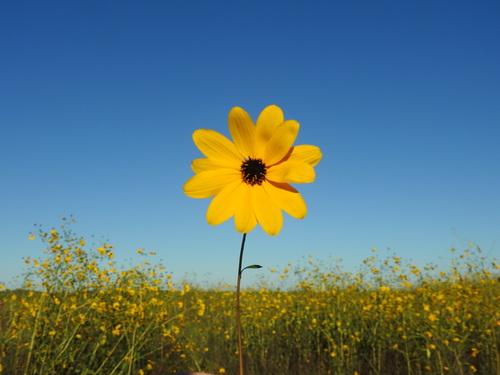
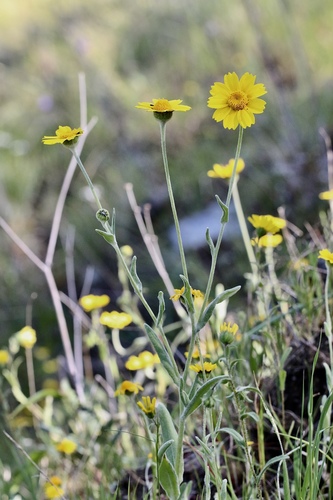
Monolopia major DC. is an annual herb that grows a slender, sometimes branching stem reaching up to around 80 centimeters tall. Its texture is usually somewhat woolly. Inflorescences at the ends of stem branches hold small hemispheric flower heads with fused phyllaries. Golden, yellow, or cream-colored ray florets, which grow up to 2 centimeters long and have three-lobed tips, surround a center filled with many disc florets. It produces an achene fruit that is roughly 2 to 4 millimeters long. This species is endemic to Central California, with confirmed existing populations located in the Inner North Coast Ranges and Inner South Coast Ranges. Most large known populations of M. major are found around San Benito Mountain in southern San Benito County. It is very similar in appearance to Monolopia lanceolata, and the two are frequently confused. They can be distinguished by the structure of their phyllaries: M. major has phyllaries fused into a cup, a trait that is most visible after senescence and fruit dispersal, while M. lanceolata has free phyllaries. Woolly hairs on M. lanceolata's phyllaries can obscure the free phyllary margins, making them appear fused, but gentle separation confirms the phyllaries are free. Additional distinguishing features include ray color: M. major rays are typically a pure, vibrant yellow, while M. lanceolata rays are a paler yellow that often fades near the tips. The two species also differ in edaphic preferences and precipitation tolerance. M. major has a very high to strict edaphic affinity for clay soils, especially vertic clays such as smectite and montmorillonite, while M. lanceolata can grow across all soil textures ranging from sandy to clayey. M. major only grows in locations where average annual precipitation is greater than roughly 11 inches per year, in habitats such as chaparral and blue oak woodland. M. lanceolata can grow in areas with more than 11 inches of annual precipitation, but also tolerates precipitation levels as low as 6 inches per year, in habitats including the San Joaquin Valley Desert and saltbrush scrub.