About Monochamus scutellatus (Say, 1824)
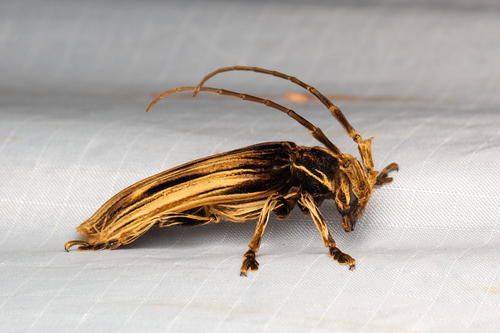
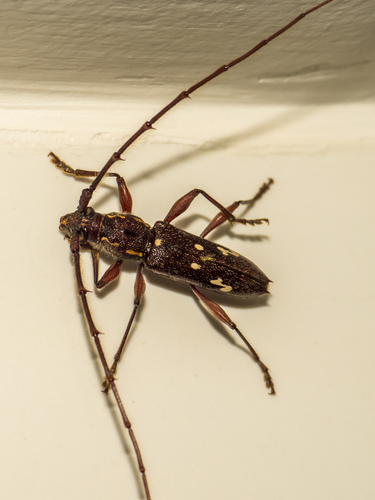
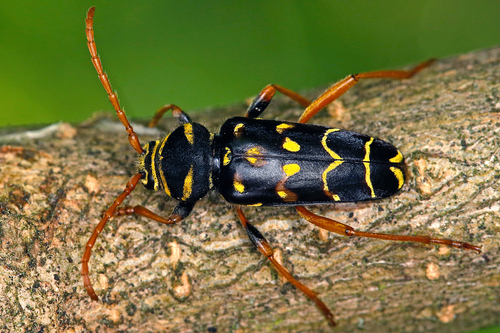
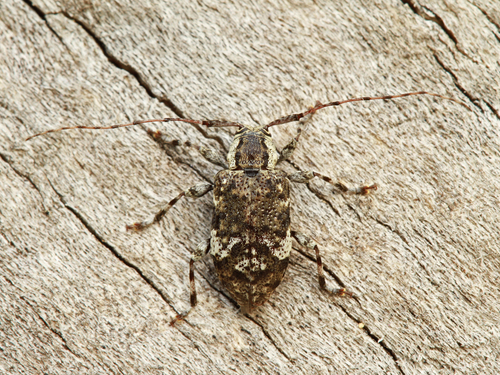
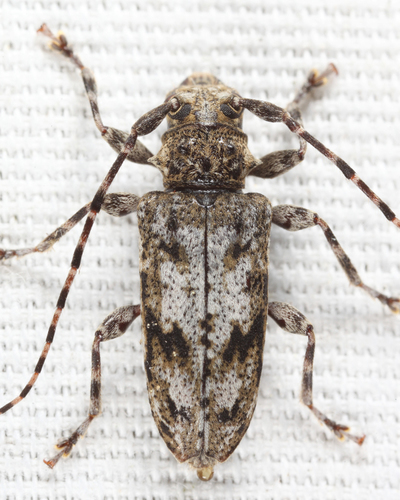
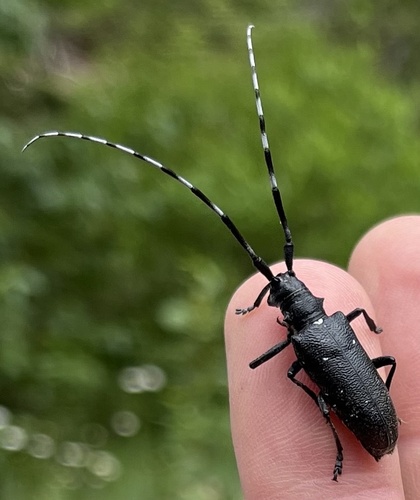
Monochamus scutellatus (Say, 1824), commonly called the white-spotted sawyer, spruce sawyer, spruce bug, or hair-eater, is a common native wood-boring beetle found across North America. Adult individuals are large-bodied and black, with very long antennae. Male antennae can reach up to twice the beetle's body length, while female antennae are only slightly longer than the body length. Both sexes have a white spot at the base of the wings, and may have additional white spots covering the wings. Both sexes also have a spine on the side of the prothorax. Most research on this species centers on its relationship to burned forests and the logging industry, with additional research interest focused on its mating behaviours. In boreal forests altered by fire, changes to plant communities and carbon flux open up competitor-free habitat for new immigrant species. Several insect groups, including the genus Monochamus, have adapted to take advantage of these conditions. M. scutellatus is a saproxylic insect, meaning at least one stage of its life cycle depends on dead or dying wood. To successfully colonize new habitat like a recently burned forest area, the habitat must be high enough quality and located close enough to prior ranges. Studies show multiple Monochamus species use bark beetle pheromones as kairomones to find suitable host habitats quickly and efficiently, letting them redirect time and energy to other activities. After post-fire forest succession, the abundance of M. scutellatus is positively correlated with fire severity, the abundance and size of burned trees, and the distance between burned and unburned land. More larvae are typically found in areas with a larger percentage of unburned forest within 500 metres, which may relate to the dietary requirements of adult beetles. Adult females prefer to lay eggs in trees with thick bark and phloem, which are generally trees with diameters greater than 8–10 centimetres. These trees are better able to limit water loss during fires, preserving the quality females prefer. Like many other insects, M. scutellatus experiences both intraspecies and interspecies competition over resources. Hughes and Hughes conducted experiments to test the outcomes of asymmetric contests between M. scutellatus and M. notatus, the eastern pine sawyer. They found that female M. scutellatus lay eggs fertilized by the male they currently share a pair-bond with, and paternity certainty drops once the pair-bond ends. As a result, females are the most valuable resource that males compete over. For females, most inter- and intraspecies competition is over oviposition holes. Female M. scutellatus usually spend more than 20 minutes using their mandibles to chew oviposition holes into tree bark. This process produces very loud noise and carries a substantial risk of detection by predators, so stealing holes chewed by other females gives females major advantages by saving time and reducing risk. The study found that within and between species, contests between larger resource holders and smaller challengers usually do not escalate, and the resource holder keeps their territory. Contests between smaller resource holders and larger challengers are more likely to escalate to fighting using the pro- and mesolegs, along with biting of legs and antennae. This is likely because Monochamus species have large, strong mandibles capable of biting off limbs or antennae, so escalated competitions are usually not worth the risk of injury. This species displays resource-defence polygyny, a mating system where males defend necessary resources that females need for reproduction. In this case, the resource is the quality of tree trunk the male has claimed; females prefer basal trunk regions with a large diameter. Females choose mates primarily based on these resources, but when resources are equal, Hughes and Hughes observed that females prefer larger males. While it has not been proven that large body size is inherited by offspring, large size may still act as an indicator of fitness and quality.