About Moneses uniflora (L.) A.Gray
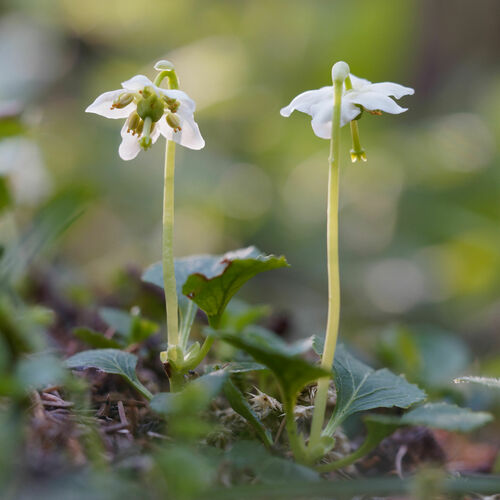
Moneses uniflora, commonly known as single delight, is a small perennial herb that typically grows no taller than 10 cm. It has a slender rhizome, with leaves growing at the base or low on the plant. The leaves are oval-elliptic to obovate, measuring 10 to 30 mm across, with small toothed edges, and their petioles are shorter than the diameter of the leaf blade. Each stem ends in a single nodding, fragrant flower, borne on a stem that ranges from 30 to 170 mm in height. The flower's corolla is 15 to 25 mm across, made of five spreading, slightly rumpled white petals that are said to look like an open white umbrella. Its oval, separate sepals are white-greenish. The flower holds ten anthers, a visible style, and a distinctive five-pronged stigma. It flowers between May and October. This species has floral traits, including poricidal anthers with small apical pores, that match the structure of flowers pollinated via buzz pollination. Its nodding flower shape and the small apical pores on its anthers allow flying bees to sonicate while in flight, releasing and transferring pollen between plants. While it attracts bees, the flower produces no nectar, and the species reproduces by seed. It grows in moist forest habitats across the Holarctic realm, and is widespread across North America and Eurasia. It flourishes in cool coniferous forest conditions, and is often found growing on moss and rotting plant material. Moneses uniflora has a long, significant history of use among several Indigenous nations across North America. The Haida people harvest this species in July, then dry it. They remove the flower and fruit parts of the plant, and boil the vegetative parts to make a tea, sometimes mixing in licorice fern and Labrador tea. This tea is used to soothe symptoms of colds, flu, smallpox and cancer, and Haida people also drink it to gain power and luck. In a Haida story called the Copper Salmon, the gambling son of a chief is sent into the forest to consume medicine: first devil's club, then Moneses uniflora, which the Haida call xiláawg. Consuming these plants cleanses his intestines and gives him the power to stop his gambling behaviour. The Makah people also boil Moneses uniflora together with Labrador tea and licorice fern, using the whole plant to soothe coughs. They also use the plant to draw blisters. The Kwakwaka'wakw people use Moneses uniflora in poultices to treat swelling and pain, because the plant causes blisters. After blisters form, they open them with broken mussel shells and smear the area with catfish oil. Once the loose skin peels away, they wash the site with gooseberry root extract and cover it with plantain leaves until it heals.