About Mondia whitei (Hook.fil.) Skeels
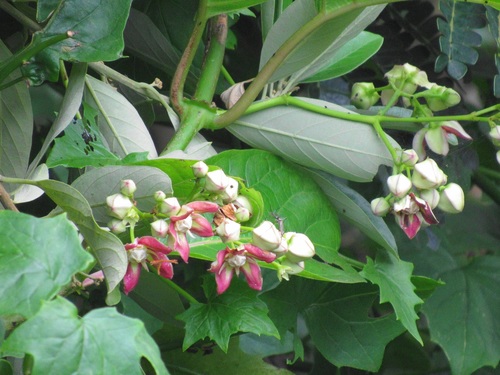
Mondia whitei (Hook.fil.) Skeels is a perennial climber that can be either herbaceous or woody, belonging to the Apocynaceae plant family. Like most members of this family, it produces milky latex. Two species are currently recognized within the Mondia genus, the other being Mondia ecornuta. This species is called 'gondolosi' in Chichewa, and known as 'mukombero' in Kenya. Its rootstock is commonly collected for use in medicine. It grows at elevations between 1000 and 1500 meters, across Sub-Saharan Africa, where it inhabits moist to wet forests, and even swampy grassland. Confirmed recorded locations for this species include Guinea, Nigeria, Cameroon, the Sudan, Uganda, Kenya, Tanzania, Zimbabwe, Malawi, Mozambique, South Africa, Eswatini, and Angola. In Kenya, collection of this plant’s roots is so intense that it often kills the individual plants. There are existing initiatives that propagate this species to meet commercial demand, and that work to re-establish wild populations of the species. Older stems of Mondia whitei become woody, and the species grows from a tuberous rootstock. The rootstock has a flavor similar to ginger or liquorice, and an aroma that resembles vanilla. Its leaves are oppositely arranged, large, measuring 100–300 mm long by 50–150 mm wide, and have a cordate base. The leaf petioles are 30–55 mm long, and both the petioles and the veins on the lower leaf surface are often reddish-purple. The false stipules of this species are large and fimbriaceous. Its inflorescence is axillary and branched, and individual flowers are short-lived, lasting only 3 to 4 days. The petals are reddish-purple, around 14 mm long, with a green edge. Its flowers are unusually large for members of the subfamily Periplocoideae, and have an unpleasant malodorous fruity scent that becomes stronger as the day goes on. It produces paired large semi-woody fruits called follicles, which measure 75–100 mm long by 44 mm wide, and have a velvety surface. The genus name Mondia is derived from the Zulu word for the plant, 'umondi'. The species epithet whitei honors A.S. White, a South African farmer who sent plant specimens to John Croumbie Brown, Colonial Botanist at the Cape, who then passed the specimens on to Joseph Dalton Hooker, who formally described the species.