About Momordica foetida Schum.
Momordica foetida Schum. is a perennial climbing vine native to tropical Africa, closely related to bitter melon (M. charantia) and balsam apple (M. balsamina). Its species epithet "foetida", meaning "bad-smelling", refers to the plant’s unpleasant odor. This species was previously classified under two other scientific names: M. morkorra (A. Rich) and M. cordata (Cogn.).
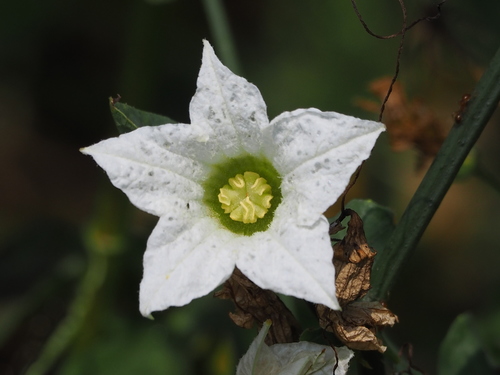
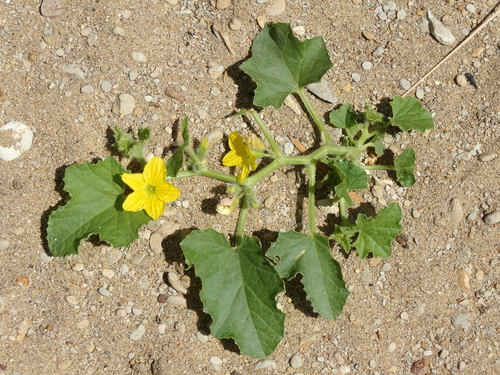
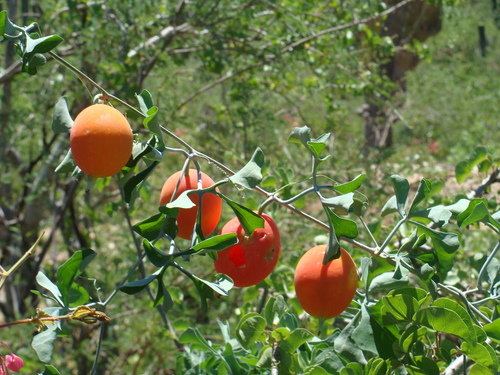
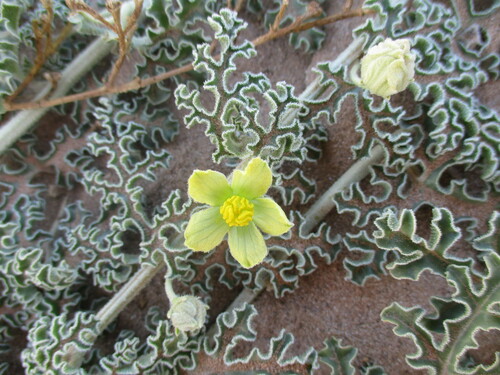
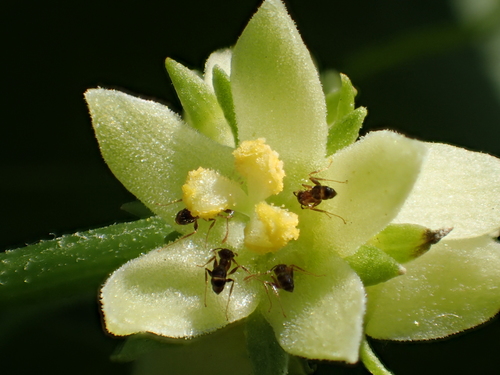
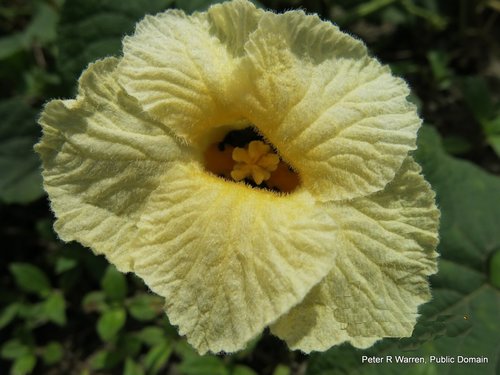
M. foetida grows at forest edges, similar habitats such as disturbed land and cultivated land, as well as in woodland and wooded grassland. It has wrinkled, heart-shaped leaves with irregular edges that grow up to 18 centimeters wide. Its flowers range in color from yellow to yellow-orange. The plant produces prolate spheroid fruit 3.5–7.5 cm long and 2.5–5 cm wide that are bright orange and covered in soft spines. When fully ripe, the fruit splits from the bottom into three valves, revealing a cluster of black seeds; each individual seed is covered by a bright red, sweet, sticky pulp. M. foetida has perennial tuberous roots.
Local common names for M. foetida include: concombre sauvage (French for "wild cucumber"), nyanya-nua, sσprσpσ, kakle, awoduan (meaning "snake food"), aoasongo, gaayama, nanïa, n-gessannia, boobo, bobonowron, vovolé, vovoné vono, hepa, ìsúgū, alu-osi, akb’an’udene, ejìnrìn, tsekiri, and a-bos-a-wir.
In folk medicine and local use, an Ivorian preparation made from M. foetida leaves is used as an aphrodisiac; women also take this preparation as an emmenagogue and to assist with childbirth. In Uganda, tea brewed from M. foetida leaves or roots is used as an abortifacient and an ecbolic. For food use, although M. foetida leaves have a bitter taste, they are eaten in Gabon and Malawi. The plant’s fruit is edible, and is consumed in multiple countries including Ghana, Gabon, Sudan, and Tanganyika. In Sudan, the root of M. foetida is considered edible.
Like its relative M. charantia, M. foetida contains a number of bioactive compounds. Known compounds found in the plant include sitosteryl glucoside, 5,25-stigmastadien-3β-yl glucoside, 1β-hydroxyfriedel-6-en-3-one, and several cucurbitane-type triterpenoid derivatives.
For other practical uses, people in Malawi use M. foetida fruit as bait to trap birds. In Gabon, the leaves are soaked, sun-dried, and used as filling for cushions. In Tanganyika, the fruit pulp is thought to be poisonous to weevils, moths, and ants, and is used as an insect repellent. The presence of M. foetida is considered an indicator that the local soil is suitable for planting cocoa trees. The closest relatives of M. foetida can be observed in a molecular phylogeny that includes all species of the Momordica genus.