About Molinia caerulea (L.) Moench
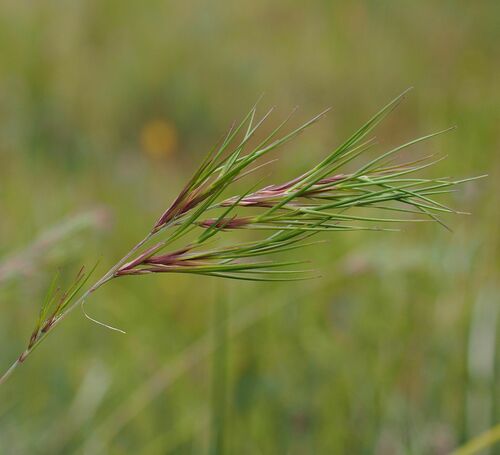
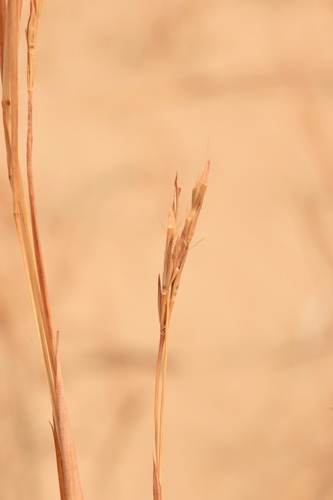
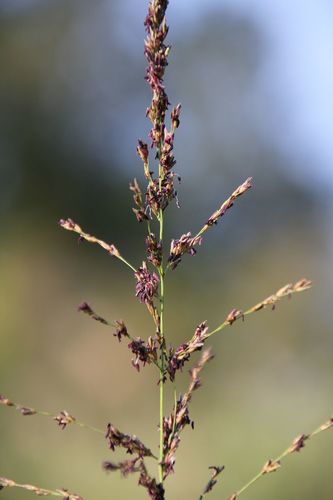
Molinia caerulea (L.) Moench is a perennial herbaceous tussock-forming bunchgrass. It grows up to 120 cm (47 in) tall, and can grow taller when sheltered by gorse and heather, with many closely packed stems. Its leaves are coarse, green, long, flat, taper to a point, and are sometimes slightly hairy on the upper surface. The dense tussock structure makes this species very resistant to heath fires. Its ligule is a ring of hairs, just like the ligule of heath grass (Danthonia decumbens). A major identifying feature of this grass is its long narrow purple spikelets; its full panicle measures 15 cm (6 in) long. It flowers between July and September, which is later than many other grass species. In ecology, the caterpillars of some Lepidoptera species use Molinia caerulea as a food plant, including the chequered skipper (Carterocephalus palaemon). The ascomycetous fungus Claviceps purpurea grows on the seeds of this species, which is also commonly called purple moor grass. Purple moor grass and rush pastures were classified as a United Kingdom Biodiversity Action Plan habitat due to their historical rarity. However, a 2025 report documented that purple moor grass is spreading across Britain and displacing other vegetation in a pattern characteristic of invasive species, even though it is a native species to the region. Over the preceding fifty years, it has spread across large upland areas in most of Wales, Dartmoor, Exmoor, the Pennines, the Peak District, North York Moors, Yorkshire Dales, and many parts of Scotland. Dense areas dominated by moor grass support very little bird or insect life; this characteristic has been described as forming a "terrestrial dead zone" or desert. Thick moor grass stands are also difficult for humans to walk through. Herbivores do not control this grass, as they prefer other plant species over it, and will not eat it at all after early summer, when its nutritional value drops sharply. It is also unaffected by disease, and is not altered by the natural successional processes that typically cause grassland to transition to other plant communities such as temperate rainforest. The spread of this species is driven largely by human activity. Incentives for farmers to increase livestock numbers, and the practice of burning moorland to produce fresh vegetation for grazing animals, have pushed many environments now dominated by Molinia past the capacity to maintain a natural ecological balance. Heavy deposition of nitrogen that accumulates in rainfall from livestock farming, vehicle traffic, and industrial sources, plus the drainage of naturally wet peat bogs, also contribute to this species' spread. Molinia's deep roots protect it from the controlled burning that destroys other competing plant species. Most common methods used to remove invasive spreading Molinia, including burning, herbicide application, and livestock grazing, only provide temporary control, and the moor grass quickly recolonises any cleared areas. Methods such as blocking land drainage to restore original soil moisture levels, planting sphagnum moss to restore peat bog habitats, planting trees, and excluding livestock are currently being trialled to address the spread and restore areas that have been overtaken by Molinia. In cultivation, Molinia caerulea is grown for its panicles of purple spikelets that grow on yellow stems. Cultivated plants grow to 1.5 m (5 ft) tall and 40 cm (16 in) broad. Numerous cultivars have been selected for garden use. The following cultivars have gained the Royal Horticultural Society's Award of Garden Merit: M. caerulea subsp. arundinacea 'Windspiel', M. caerulea subsp. caerulea 'Edith Dudszus', M. caerulea subsp. caerulea 'Moorhexe', M. caerulea subsp. caerulea 'Poul Petersen', and M. caerulea subsp. caerulea 'Variegata'.