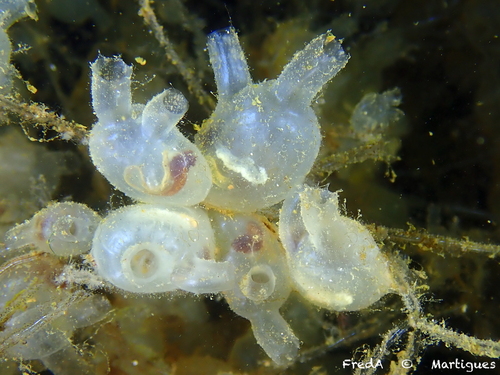
About Molgula manhattensis (De Kay, 1843)
Molgula manhattensis (De Kay, 1843) is a small, spherical ascidian (sea squirt) that is brownish-grey, somewhat translucent, and has a soft, rubbery texture. Like other ascidians, it has two siphons—an incurrent siphon and an excurrent siphon—that it uses to draw water for ventilation and filter-feeding, as well as to release gametes. It is hermaphroditic, and releases both sperm and eggs into the water for external fertilization. This differs from some other Molgula species, such as M. citrina, which may be viviparous. Its tunic is covered in many small fibrils. This species occurs from the intertidal zone down to 300 feet in depth. It can attach to solid substrates including rocks, pilings, buoys, sand, and solid organisms. It can tolerate water temperatures between approximately 50 °F and 80 °F. It inhabits water with a salinity ranging from 33.270 to 36.231 PSS, and oxygen concentrations between 3.960 and 6.328 mL/L.

